




Starting with consistent plants is the bedrock of a successful cultivation facility. Whether you are running a single light or a thousand, the ability to replicate your best genetics through cloning is what separates a lucky harvest from a calculated, repeatable process.
Cloning is the method of asexual reproduction used to create a genetically identical copy of a specific plant. This guide provides a comprehensive, peer-to-peer breakdown of how to clone cannabis successfully, specifically utilizing the efficiency of the Athena VPDome to maintain the perfect environment for healthy roots.
What Is Cloning in Cannabis?
In cannabis cultivation, cloning is the process of taking a cutting from a vegetative mother plant and encouraging it to develop its own root system. Unlike growing from seed, which creates a unique genetic phenotype with potential variations in yield, structure, and potency, a clone is an exact genetic replica of the donor plant.
If you have a specific cultivar that yields high, smells incredible, and resists pests, cloning allows you to preserve those exact traits for future runs.
Why Clone Cannabis Instead of Growing from Seed?
For commercial cultivators and serious home growers, the primary advantage of cloning is consistency.
- Genetic Reliability: Clones replicate the known potential of the mother plant. You know exactly what the growth structure, flowering time, and chemotype profile will be.
- Speed: Clones bypass the germination and seedling stages, giving you a faster start to the vegetative phase.
- Efficiency: Because clones are the same age as the mother plant biologically, they can be flipped to the flowering stage much faster than seed-grown plants.
However, cloning does carry risks. Clones can inherit pathogens, pests, or viruses (like Hop Latent Viroid) from the mother plant. Therefore, maintaining a clean mother stock and following strict sanitation protocols is non-negotiable.
When to Clone a Cannabis Plant
Timing is critical. You should only take clones from a cannabis plant that is in the vegetative stage. Attempting to clone a plant that has already begun flowering (a process called monster cropping) takes significantly longer to root and revegetate, leading to inconsistent growth.
Mother Plant Selection: Limit cuttings when mother plants are young, typically under 60 days. Light topping or removing fan leaves from dense areas encourages lateral branching and increases future cutting production. Rotate mother plants regularly and avoid using stock older than 185 days, as older plants become woodier, lose vigor, and are more likely to harbor pests or disease. Never take cuttings from any plant showing signs of stress, nutrient imbalance, or pest pressure.
What You’ll Need for Successful Cloning
Before you make your first cut, gather and sterilize your tools. You will need:
- 2 Pairs of Sharp Scissors: Scissors should be sanitized between each mother plant to prevent the transmission of viruses or diseases.
- Fresh Scalpel or Razor Blade: A sharp, sterile blade is necessary to make a clean cut without damaging plant tissue.
- Rooting Gel: A cloning gel (like Athena Cuts) is preferred over powder because it adheres to the stem better and seals the cut tissue.
- Rooting Cubes: Rockwool cubes are commonly used for their water retention and sterility. Peat cubes are also a common and reliable option.
- Metal Shelving Unit 5-Tier (72”H x 48”W x 18”D): A standard shelving unit found at most hardware stores that allows you to hold multiple clone trays in a compact area.
- Athena VPDome: A fabric rack cover that holds 16 standard clone trays(4 trays per level), replacing individual plastic domes to streamline workflow and ensure uniform VPD.
- 4’ LED Grow Light: LED clone lights provide low heat and efficient light output suitable for early growth. Two to three lights per rack are typically sufficient.
- Sanitization Supplies:
- 10 % household Bleach: In a small pitcher or solo cup mix 1 part bleach to 9 parts water. This will be used to sanitize cutting tools between mother plants to prevent diseases and viruses like Hop Latent Viroid.
- Athena Reset: In a small pitcher or solo cup at a rate of 1 oz per gallon.
How to Take a Cannabis Cutting
The mechanical process of taking a clone requires precision to prevent embolisms (air bubbles entering the stem) and infection.
- Prepare the Medium: Soak your rockwool cubes in a nutrient solution (use the Pre-soak Clone Recipe found on your feed schedule). 1.0 EC for Blended Line and 2.0 EC for Pro Line and a pH of 5.6. Allow them to soak for at least 10 minutes, then drain excess water without squeezing the cube.
- Select the Branch: Choose healthy branches from the upper or middle sections of the mother plant. Look for branches that are at least 1/8 inch thick and about 6 inches long. Avoid cuttings with hollow stems; branches should have a solid white pith in the center. Hollow stems allow bacteria to enter the cutting and can reduce rooting success. Taking cuttings 5-7 days after topping the plant can help ensure stems are solid.
- The Cut: Using sterile scissors, remove the branch from the mother plant and trim the cutting to approximately 5 inches in height. Remove the lower nodes and fan leaves, leaving only the top set of leaves. Scissors should be soaked for 30 seconds in a bleach solution between different mother plants.
- Cupping (Optional but Recommended): Place the fresh cuttings into a cup of nutrient solution immediately after removal from the mother. This keeps the plant hydrated for 1–2 hours while you process the batch.
- The Final Cut: Using a clean scalpel or razor blade, make a clean cut through the bottom of the stem at a 45-degree angle. This increases the surface area for water uptake and exposes the inner tissue where roots will form.
- Apply Rooting Gel: Squeeze a pea-sized amount of Cuts gel directly on top of the hole of the rooting cube (do not insert Cuts nozzle into the cube), or dip the stem into the gel.
- Plug the Clone: Gently insert the stem into the pre-soaked rooting cube until the end of the cutting is positioned about halfway into the cube. Do not force it, as bending the stem can damage the vascular tissue.
Optimizing the Environment with the Athena VPDome
Once plugged, the clone has no roots to uptake water. It must rely on its leaves to absorb moisture from the air until roots form. This makes environmental control the single most important factor in successful cloning.
Traditional cloning involves individual domes for each tray, which requires significant labor to vent daily. The Athena VPDome simplifies this by creating a large, consistent microclimate for up to 16 trays at once.
- Uniform VPD: The VPDome maintains a consistent Vapor Pressure Deficit (VPD), ensuring that all clones in the rack experience the same humidity and temperature, reducing mortality and speeding up rooting.
- Target Conditions: Maintain a temperature of 75°F–80°F and a humidity of 80–95% inside the dome.
- Capacity: If you are not filling the VPDome with a full 16 trays, place a small humidifier inside the cover to make up the difference in moisture.
Caring for Cannabis Clones Using the VPDome Procedure
Rooting typically takes 10 to 14 days. During this time, you must manage the moisture levels carefully to encourage the roots to "search" for water.
- Day 1 (Fill): Fill the shelving with freshly plugged trays of clones and close the magnetic doors. Clones placed on higher shelves may have an advantage due to heat rising.
- Note: If not filling the VPDome with 16 trays of clones, optimal environmental conditions will not be achieved inside the VPDome. A small humidifier placed inside the cover can be used to make up the difference.
- Day 2 (Seal): Leave the VPDome closed all day to allow proper humidity levels to develop.
- Day 3+ (Ventilate): Begin "burping" the dome by leaving the magnetic doors half-open (with only the lower magnetic strips attached) for 5–20 minutes daily. This exchanges the air and reduces humidity slightly, encouraging transpiration.
- Monitoring: Inspect clones daily. If you see wilting, the environment is too dry. If you see mold, it is too wet. If the trays were pre-soaked correctly, feed again on Days 5, 7, 9, and 11, maintaining a 30–35% dryback.
- Hardening Off: Around Day 10–15, once roots are established, the clones should be hardened off. You can leave the magnetic doors completely open and strapped back against the sides.
Sanitation Tip: Before folding the doors back, spray and wipe them with a solution of Athena Reset (1 oz per gallon) to prevent the growth of pathogens.
Transplanting Rooted Clones
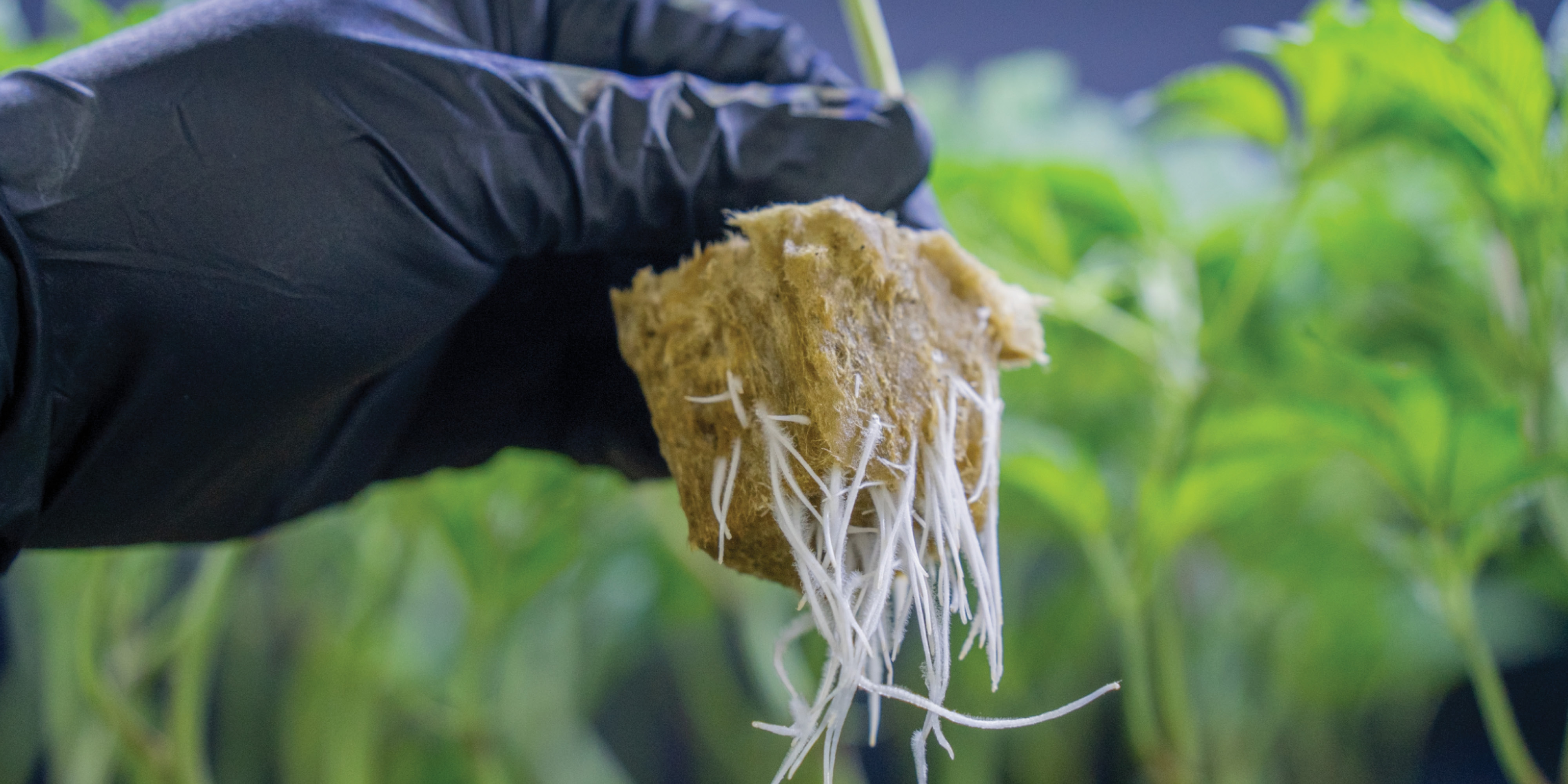
You will know your clones are ready when you see white, fuzzy roots protruding from the bottom and sides of the rockwool cube. Once a healthy root system is established (usually around Day 14), the plants are ready to be transplanted into their final growing medium, whether that is soil, coco, or a hydroponic system.
Common Mistakes in Cloning Cannabis
- Wrong Lighting: Using heat-emitting lights like T5 fluorescents inside a VPDome is not compatible and can overheat the clones. Always use low-heat LED bars.
- Dirty Tools: Failure to sterilize scissors can transfer viruses like HLV directly into the vascular system of the new plant.
- Overwatering: If the rockwool is saturated and sitting in standing water, the stems will rot before they root.
Why Successful Cloning Matters for Cannabis Growers
Mastering how to clone cannabis gives you total control over your garden. By utilizing tools like the Athena VPDome, you can save 2–4 hours of labor per month per rack while achieving higher success rates. This consistency eliminates the variability of seeds and sets your cultivation facility up for "The Perfect Run."
Subscribe to our newsletter
Athena® exists to support the modern grower, no matter the scale. Our core principle is to formulate products that improve quality, reduce costs and drive consistency. Athena® was born in the grow rooms of Los Angeles, California, where we are always in pursuit of the perfect run. As the weight of being a cultivator increases, we exist to make the complex simple.
Related posts

Predatory Mites for Cannabis: Pest Targets and Practical Use

Wet Trim vs Dry Trim: Understanding Cannabis Trimming Methods
What Is Cannabis Photoperiod? A Grower's Guide to Light Cycles

