




Understanding EC in Cannabis: How to Measure, Interpret, and Manage Nutrient Levels
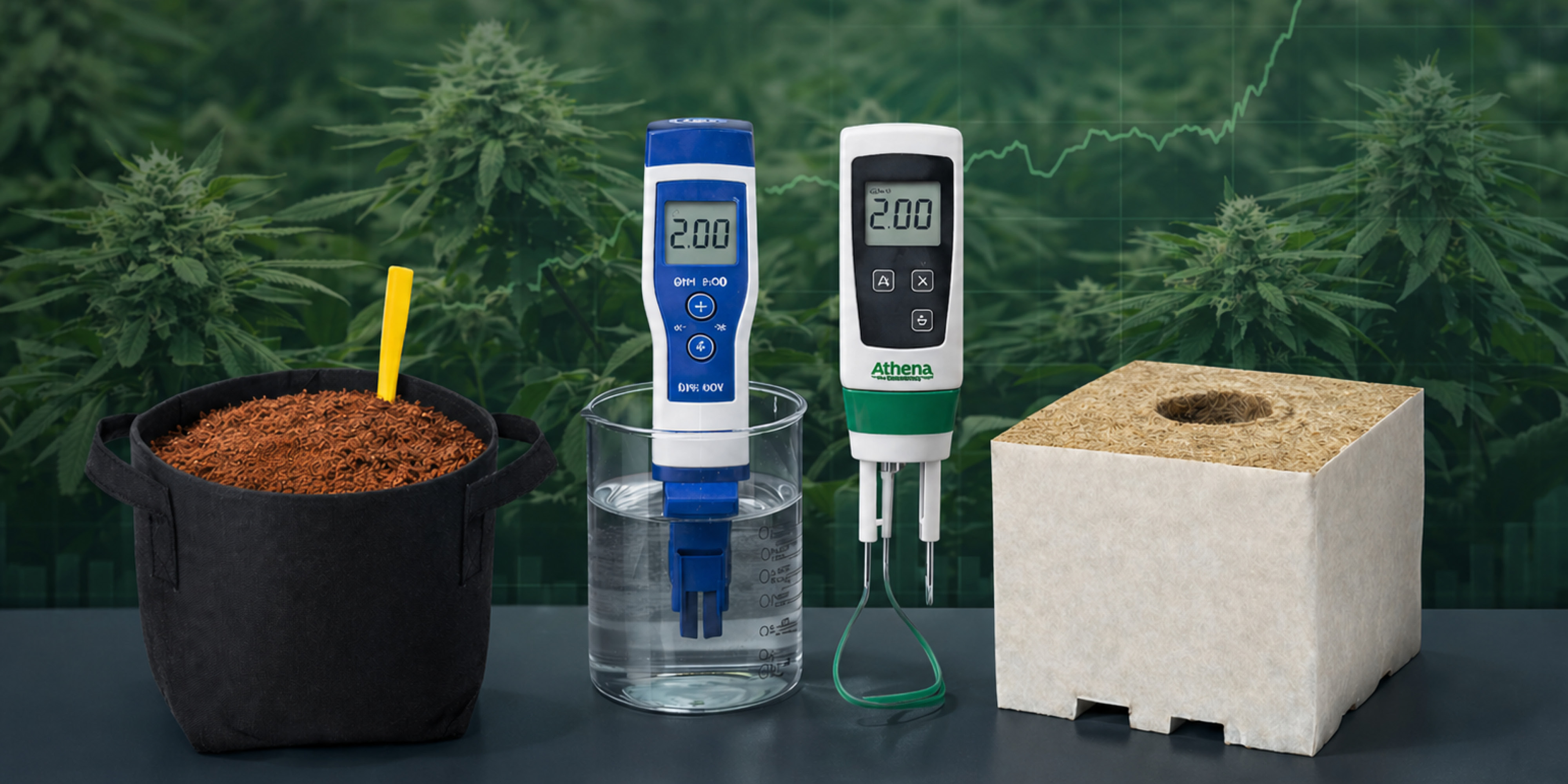
Electrical conductivity (EC) is one of the most important metrics in cannabis cultivation. Along with VWC and pH, it defines what’s happening in the root zone and how effectively nutrients are being delivered and absorbed.
Most growers measure EC. Fewer use it to actually drive plant performance.
When managed correctly, EC becomes more than just a number. It becomes a tool to control plant stress, steer growth, and improve consistency across an entire facility.
This guide explains how to measure EC in cannabis, what EC levels to target, and how to use EC as a tool to control nutrient concentration and plant performance.
What Is EC and Why It Matters for Nutrient Uptake
Electrical conductivity (EC) quantifies the total concentration of dissolved ions in a solution. In cannabis cultivation, these ions primarily come from mineral fertilizers, including nitrate, potassium, calcium, magnesium, sulfate, and phosphate.
In cultivation, EC is expressed in millisiemens per centimeter (mS/cm), typically shortened to “EC.”
For example, running 2.5 EC means 2.5 mS/cm.
As EC increases, the ionic strength of the solution increases, meaning more nutrients are present per unit volume.
However, plant uptake is not driven by concentration alone. It is governed by water potential gradients between the root zone and the plant. EC directly influences the osmotic component of that gradient.
When EC Is Elevated
The osmotic potential of the solution becomes more negative, reducing the plant’s ability to take up water. This can lead to:
- Reduced transpiration
- Decreased nutrient transport through mass flow
- Increased physiological stress
When EC Is Too Low
Water uptake is less restricted, but nutrient availability becomes limiting. This can lead to:
- Reduced growth rate
- Pale or underdeveloped plants
- Slower flower development
In practice, EC functions as a root zone control variable, influencing:
- Nutrient availability and ion balance
- Osmotic pressure and water uptake dynamics
- Transpiration and mass flow of nutrients
- Plant stress responses
- Growth rate and morphological expression
Managing EC is ultimately about controlling how the plant interacts with its root zone environment, not just what is delivered in the feed.
EC vs. PPM: Understanding Nutrient Concentration
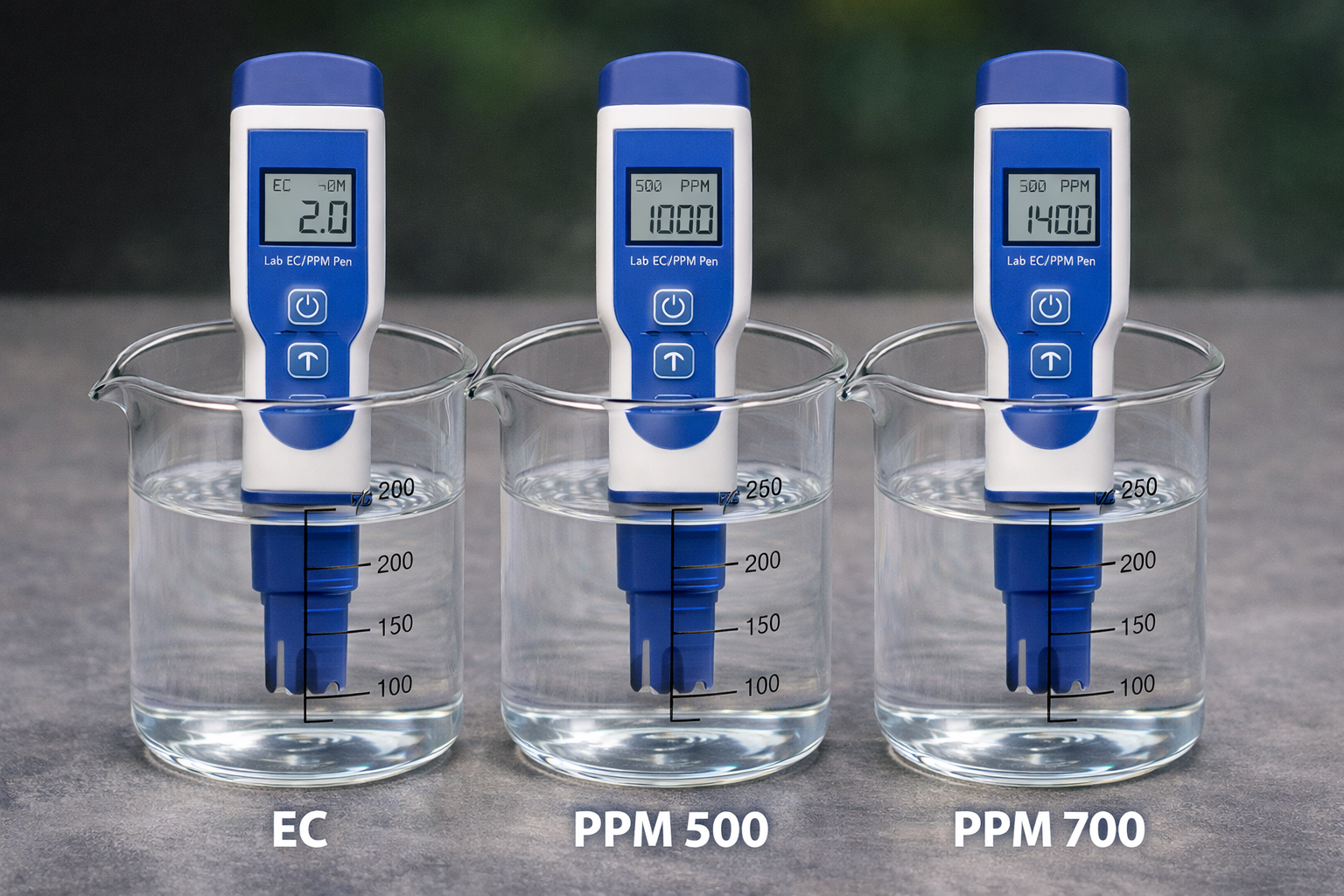
EC and PPM both describe nutrient concentration in a solution, but they are fundamentally different in how they are derived.
EC is a direct physical measurement of a solution’s ability to conduct electrical current, which correlates with the concentration of dissolved ions. It is consistent, reproducible, and independent of assumptions about solution composition.
PPM (parts per million), on the other hand, is a calculated value derived from EC using a conversion factor. These factors are based on assumed reference solutions and vary depending on the meter and scale used.
Common conversion scales include:
- 500 scale (NaCl-based): 1.0 EC ≈ 500 ppm
- 700 scale (KCl-based): 1.0 EC ≈ 700 ppm
These scales are based on how specific salts behave in water. In reality, your nutrient solution is not made up of sodium (Na) or potassium (K) alone, but a complex mix of ions including nitrate, sulfate, calcium, magnesium, and others, each contributing differently to electrical conductivity.
Because of this, ppm values are always approximations based on assumptions, not true measurements.
This is why two growers can run the exact same solution at the same EC and report very different ppm values:
- 2.0 EC = 1000 ppm (500 scale)
- 2.0 EC = 1400 ppm (700 scale)
Same solution. Different math.
For this reason, EC should be treated as the standard when discussing nutrient strength.
EC provides a direct, unambiguous measurement of solution concentration, reducing misinterpretation and eliminating conversion discrepancies.
Input EC vs. Substrate EC: Understanding Root Zone Nutrient Levels
Understanding EC at the solution level is only part of the equation. In practice, what matters is how EC behaves inside the root zone over time.
When running a precision irrigation strategy, it's important to distinguish between two different EC measurements:
Input EC
The EC of the nutrient solution being delivered during irrigation events. This is what you mix and what your feed program specifies.
Pore Water EC (pwEC)
Also referred to as substrate EC, this is the EC of the solution within the pore space of the substrate. This is what sensors measure, and it reflects how salts are accumulating or being removed in the root zone.
Input EC and substrate EC are related, but they are not the same. Managing the relationship between them is the core of root zone control.
In practice, achieving target substrate EC often requires adjusting input EC alongside irrigation strategy. Increasing or decreasing feed EC may be necessary depending on plant demand, drybacks, and environmental conditions.
Cannabis Substrate EC Strategy by Growth Stage (Veg to Harvest)
While many growers look for a cannabis EC chart, the reality is that EC targets depend on growth stage, environment, and irrigation strategy.
On the Athena Pro Line, substrate EC targets are tied directly to crop steering strategy and measured as pore water EC (pwEC).
Vegetative Stage
- Substrate EC target: 3.0–5.0 (target 4–5 by flip to flower)
- Strategy: Vegetative steering — high runoff, small dryback, low substrate EC
- Goal: Promote rapid root, shoot, and leaf development
Flower Stretch (Weeks 1–4)
- Substrate EC target: 4.0–10.0
- Strategy: Generative steering — reduced runoff, large dryback, EC stacking
- Goal: Initiate flower site formation, reduce internodal spacing
Flower Bulk (Weeks 5–7)
- Substrate EC target: 3.5–6.0
- Strategy: Vegetative steering — increase runoff to reduce built-up EC, support bud swell
- Goal: Maximize bud size
Flower Finish (Weeks 8–10)
- Substrate EC target: 3.0–4.0
- Strategy: Hybrid — vegetative substrate EC management + generative dryback
- Goal: Reduce accumulated substrate EC, encourage ripening
These are not fixed rules. Actual targets depend on cultivar, environment, VPD, and irrigation strategy.
Feed EC vs. Substrate EC: What the Difference Means
One of the most important insights comes from comparing input EC to what is happening in the root zone.
Input EC defines what is being delivered, while substrate EC reflects what the plant is actually experiencing.
If substrate EC is higher than input EC:
- Salts are accumulating in the root zone
- Typically caused by reduced runoff or larger drybacks
- Osmotic stress risk increases if not controlled
If substrate EC is lower than input EC:
- The root zone is being diluted
- Typically caused by higher runoff volumes
- Often intentional during vegetative steering
The goal is not to eliminate the gap. The goal is to control it.
Substrate EC vs. Runoff EC: How to Interpret and Validate Measurements
Substrate EC (pore water EC) is the most accurate representation of root zone conditions. Runoff EC should be used as a reference tool to help interpret and validate what is happening in the system.
How Runoff EC Changes Throughout the Day
Runoff EC changes throughout the day and must be interpreted in context:
- After an overnight dryback, the first runoff event will often show elevated EC due to salt concentration in the substrate
- As irrigation continues and the substrate rehydrates, EC levels begin to stabilize
For more consistent readings, runoff EC is best measured around midday once irrigation events have balanced moisture levels in the root zone and plants are at peak transpiration.
How to Properly Measure Runoff EC
- Collect runoff equal to approximately 10% of the container volume
- Smaller samples can skew readings and overrepresent localized conditions
How to Interpret Runoff EC
- Runoff EC will typically fall within ±1.0 EC of substrate EC due to dilution effects
- Use runoff EC as a directional reference, not an exact measurement
Using Runoff EC to Validate Substrate EC
Comparing runoff EC to substrate EC can help confirm system accuracy:
- If readings are aligned → system and sensors are likely accurate
- If readings differ significantly → may indicate:
- Sensor calibration issues
- Uneven irrigation distribution
- Localized salt buildup
If discrepancies persist, it warrants a closer look at system performance, including sensor calibration and irrigation uniformity.
Runoff EC is a reference tool. Substrate EC is the control point.
High Substrate EC: Causes, Symptoms, and How to Fix It
Elevated substrate EC can be beneficial when used intentionally during specific growth stages, particularly for driving generative responses. However, when not properly managed, it can quickly lead to stress and reduced performance.
Common causes:
- Insufficient runoff over time
- Aggressive drybacks without recovery
- High input EC without a compensating irrigation strategy
- Poor system uniformity
Symptoms:
- Dark, overly green plants
- Excessively tight internodal spacing
- Leaf tip burn (necrosis)
- Reduced vigor
- Slowed growth and flower development
Correction:
- Increase runoff to flush accumulated salts
- Reduce dryback depth temporarily
- Verify system uniformity
High EC is not always a problem. When controlled, it is a tool. When unmanaged, it becomes a risk.
Low Substrate EC: Causes, Symptoms, and How to Fix It
Low substrate EC conditions reduce nutrient availability and limit overall growth potential.
Common causes:
- Excessive runoff
- Overwatering or overly frequent irrigation
- Underfeeding
- Mixing inconsistencies
Symptoms:
- Pale, lime green plants
- Elongated growth
- Purpling stems
- Reduced vigor
- Slower growth and flower development
Correction:
- Increase input EC
- Reduce runoff volume
- Adjust irrigation timing
- Verify mixing accuracy
Low EC often results in wasted inputs and reduced yield potential.
How EC Behaves in Different Cannabis Growing Media (Coco vs Rockwool)
The growing media plays a major role in how EC behaves in the root zone. While input EC may be the same, the way salts accumulate, move, and respond to irrigation can vary significantly depending on the media.
This is largely influenced by the media’s ability to retain water and ions, which affects how stable or reactive EC is over time.
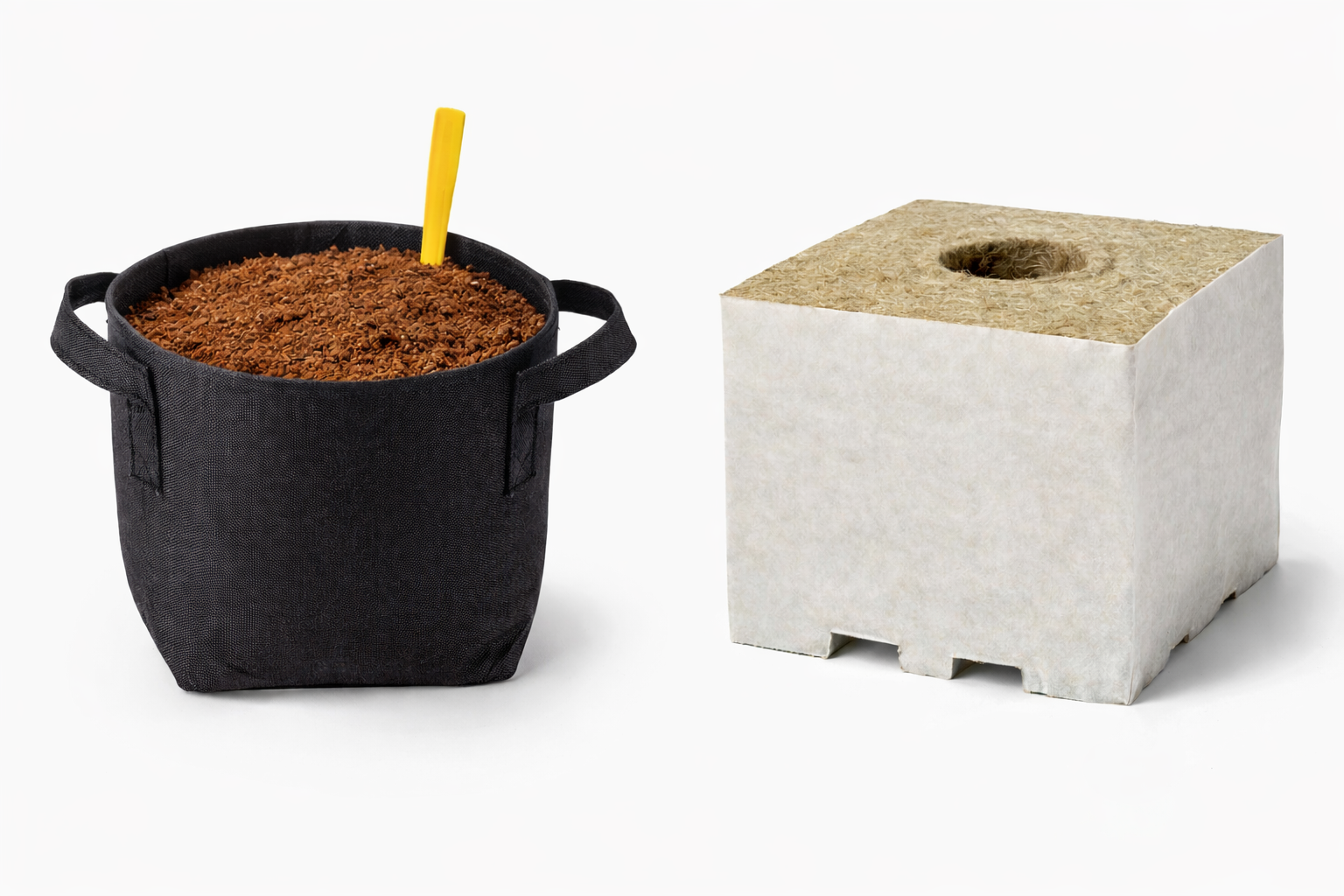
Coco
- Moderate ion retention (CEC)
- EC builds gradually without proper runoff
- More stable EC behavior over time
- More forgiving to irrigation inconsistencies
Rockwool
- Low ion retention (CEC)
- EC responds rapidly to irrigation changes
- More precise control over root zone conditions
- Less forgiving and requires tighter management
Media type determines how quickly EC changes and how tightly it must be controlled. Coco provides more buffering and stability, while rockwool allows for faster adjustments but requires greater precision.
How to Monitor and Manage EC in Cannabis for Consistent Results
Effective EC management requires consistent measurement, proper interpretation, and alignment with irrigation strategy. It is not about reacting to individual readings, but understanding trends over time.
What to Measure
- Measure input EC at every mix
- Monitor substrate EC daily
- Use runoff EC as a reference to validate root zone conditions
How to Interpret EC
- Track trends over time instead of reacting to single data points
- Compare input EC to substrate EC to understand accumulation or dilution
- Use midday readings for more stable and representative data
System Checks
- Verify equipment calibration regularly
- Ensure irrigation uniformity across the system
- Confirm sensors are reading accurately through cross-checking
EC should never be viewed in isolation. It is directly tied to irrigation strategy and environmental conditions.
Using EC for Cannabis Crop Steering and Plant Performance
EC is one of the most powerful tools for crop steering, allowing growers to influence plant growth, structure, and development through the root zone.
How EC Influences Plant Response
- Lower EC supports vegetative growth and biomass accumulation
- Higher EC during flower stretch promotes generative responses, including tighter structure and increased flower site development
How EC Changes Throughout the Crop Cycle
- Early stages → lower EC to drive growth and expansion
- Flower stretch → higher EC to control structure and initiate generative responses
- Late flower → reduce accumulated EC while maintaining controlled stress for ripening
Key Considerations
- EC management is dynamic and must change with plant stage
- Stacking too many stress factors at once can overwhelm the plant
- Environment sets the ceiling, and the root zone operates within it
Key Takeaway
EC is a tool for steering plant response, not a fixed target.
How to Use EC to Improve Cannabis Yield, Quality, and Consistency
EC is not just a number on a meter. It reflects how effectively the root zone is being managed and how consistently nutrients and water are being delivered to the plant.
What Drives Consistency
- Stable EC leads to consistent plant performance
- Predictable EC allows for more precise control over growth and development
- Unmanaged EC increases variability and reduces overall performance
How to Approach EC Management
- Focus on building a system where EC behaves predictably
- Adjust EC intentionally based on plant response and growth stage
- Avoid chasing a single target number
Key Takeaway
When combined with precise irrigation and environmental control, EC becomes one of the most reliable levers for improving yield, quality, and consistency.
Learn More About EC, Irrigation Strategy, and Cannabis Nutrient Management
Follow @Athena.Ag and join the Growers Hub to see how EC, drybacks, and irrigation strategy are applied in real trials and commercial cultivation environments.
Subscribe to our newsletter
Athena® exists to support the modern grower, no matter the scale. Our core principle is to formulate products that improve quality, reduce costs and drive consistency. Athena® was born in the grow rooms of Los Angeles, California, where we are always in pursuit of the perfect run. As the weight of being a cultivator increases, we exist to make the complex simple.
Related posts

What Is Cannabis Photoperiod? A Grower's Guide to Light Cycles

Cal-Mag Deficiency in Cannabis: How to Diagnose Calcium and Magnesium Deficiencies
What Is VPD? Understanding Vapor Pressure Deficit for Cannabis Growing

