




Cannabis nutrients provide the mineral elements a plant needs to build roots, leaves, stems, flowers, enzymes, and defensive compounds. They influence how quickly the canopy develops, how efficiently the plant uses light and water, and whether it can support healthy flower production through harvest.
The goal of a nutrient program is not to push the highest possible concentration. It is to deliver a complete and balanced supply that matches the crop's stage of growth, growing medium, irrigation strategy, and environment. More fertilizer does not automatically produce more yield. When the root zone becomes unstable, additional fertilizer can work against plant performance.
This guide explains what cannabis nutrients do, how base nutrients and additives differ, how to choose a nutrient system, and how to build a feeding strategy that remains consistent from propagation through flowering.
Understanding Nutrients and the Cannabis Plant
Cannabis requires essential mineral elements that are generally grouped as primary macronutrients, secondary nutrients, and micronutrients. The groups describe how much of each element the plant uses, not how important that element is. A micronutrient may be required in a very small concentration, but growth can still slow if it is unavailable.
The three primary macronutrients are nitrogen, phosphorus, and potassium, commonly shown as the N-P-K values on a fertilizer label.
- Nitrogen supports chlorophyll formation, amino acids, proteins, and vegetative growth.
- Phosphorus is involved in energy transfer, root development, and reproductive growth.
- Potassium supports water regulation, enzyme activity, carbohydrate movement, and overall plant function.
Secondary nutrients include calcium, magnesium, and sulfur. Calcium contributes to cell structure and new tissue development. Magnesium sits at the center of the chlorophyll molecule and is essential for photosynthesis. Sulfur is used in amino acids, proteins, and other metabolic compounds.
Cannabis also needs micronutrients such as iron, manganese, zinc, copper, boron, molybdenum, chlorine, and nickel. These elements support enzyme activity and many other plant processes. A complete cannabis nutrient program supplies them in appropriate proportions instead of treating them as optional extras.
Plants absorb most mineral nutrients as dissolved ions through the roots. That makes nutrient uptake dependent on more than the fertilizer label. Root health, moisture, oxygen, temperature, pH, and the concentration of dissolved salts all affect whether the plant can use what has been supplied.
How Nutrient Needs Change Through the Growth Cycle
Plant nutrition changes as cannabis moves through propagation, the vegetative stage, and flowering. Young plants have small root systems and relatively low demand. They need complete nutrition, but excessive concentration can make water uptake more difficult and slow establishment.
During the vegetative phase, the plant builds roots, stems, leaves, and canopy. Nitrogen is important during this period, but it must remain balanced with calcium, magnesium, potassium, phosphorus, and micronutrients. Feeding only for rapid green growth can produce soft tissue, excessive stretch, or an imbalanced plant heading into flower.
During the flowering stage, demand shifts as the plant supports bud development and reproductive growth. Many feeding programs reduce the proportion of nitrogen while increasing the relative contribution of phosphorus and potassium. That does not mean nitrogen should be eliminated as soon as flowering begins. The plant still needs it for proteins, chlorophyll, and metabolism, especially during the transition and early flowering period.
Large, healthy cannabis buds are not created by phosphorus and potassium alone. Flower quality and yield depend on the full system: genetics, canopy health, light, carbon dioxide, temperature, humidity, irrigation, root-zone conditions, and balanced nutrition. A bloom nutrient can support flower production, but it cannot compensate for limitations elsewhere in the grow.
The Role of Base Nutrients and Additives
Base nutrients are the foundation of a feeding program. They are formulated to supply the complete range of essential elements needed throughout the crop cycle. Depending on the nutrient line, the base may be divided into two or more parts so calcium, phosphates, sulfates, and other ingredients remain separate until they are diluted in water.
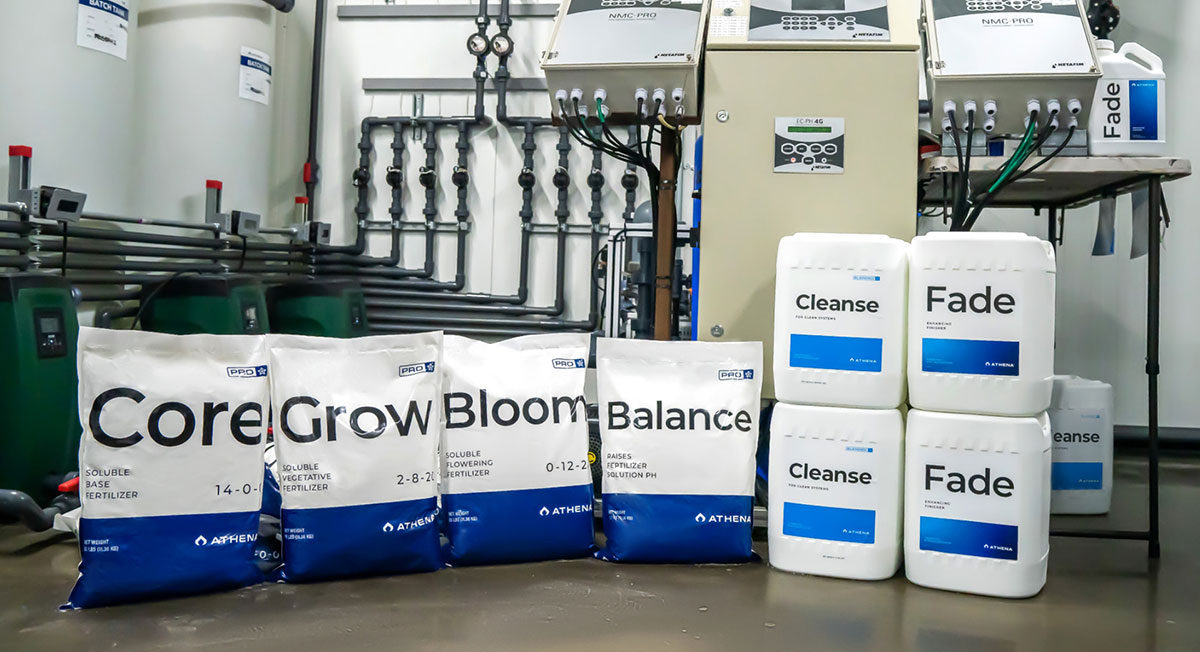
Cannabis nutrients are sold as liquids, dry soluble powders, and organic materials. Liquid nutrients are convenient to measure and may be easier for beginners to mix. Dry fertilizers are concentrated, take up less storage space, and can be efficient for commercial cultivation when stock concentrates and injection systems are managed correctly.
Additives are products used alongside the base nutrients for a specific purpose. Common examples include calcium and magnesium supplements, kelp extracts, microbial inoculants, enzymes, carbohydrates, silica products, and flowering additives. Some can be useful in the right system, but every additive also changes the nutrient mix or root-zone biology.
Before adding another product, determine what it contributes and whether the base program already supplies it. Stacking multiple supplements can unintentionally increase potassium, phosphorus, nitrogen, or other elements beyond the intended ratio. It can also raise EC, create incompatibilities in a reservoir, or make troubleshooting more difficult.
The most reliable approach is to begin with a complete base program and add complexity only when there is a defined reason and a way to evaluate the result.
How to Choose the Right Nutrients for Cannabis
The best cannabis nutrients are the ones that remain complete, soluble, and manageable in the grower's production system. A product that performs well in living soil may not be appropriate for a recirculating hydroponic system, while a clean mineral fertilizer designed for fertigation may not align with a compost-based soil program.
Start by matching the fertilizer to the growing medium.
In soil and living soil, nutrients may come from mineral fertilizer, compost, amendments, and microbial decomposition. The soil can buffer some changes, but nutrient release is influenced by moisture, temperature, biology, and the composition of the media.
In coco coir, rockwool, aeroponics, and other hydroponics systems, the grower supplies most or all nutrition through the irrigation water. These systems provide direct control, but they also require more attention to nutrient concentration, pH, mixing, runoff, and irrigation frequency.
Source water matters as well. Water can contribute calcium, magnesium, sodium, iron, alkalinity, and other dissolved minerals before fertilizer is added. A nutrient calculator or feeding schedule cannot account for the root zone accurately if the starting water is unknown.
Well-known cannabis nutrient brands include Advanced Nutrients, Fox Farm, and General Hydroponics, along with systems developed for commercial cannabis cultivation. Brand recognition alone does not determine which line is best. Compare the guaranteed analysis, intended medium, number of components, mixing requirements, solubility, technical support, and ability to scale with the operation.
Some nutrient systems are marketed with pH-management features using terms such as pH Perfect. These features may reduce adjustment under certain conditions, but growers should still measure their irrigation solution and root zone. Source water, additives, microbial activity, and crop demand can all influence pH after mixing.
Building a Consistent Feeding Schedule
A feeding schedule is a starting framework that shows which products to use and how the formula changes through the crop cycle. It should be adapted to the cultivar, plant size, environment, medium, container size, and irrigation system rather than followed without observation.
How often cannabis nutrients should be applied depends heavily on the production method. In amended soil, plant food may be incorporated into the media or applied periodically. In coco coir and hydroponic systems, nutrients are commonly delivered with each irrigation because the medium contains little stored fertility. What matters is maintaining an appropriate root-zone balance over time.
Electrical conductivity provides a practical way to monitor the total concentration of dissolved salts. EC does not identify individual elements, but it helps growers compare the strength of the input solution with what is accumulating in the substrate or reservoir. A rising root-zone EC may indicate that water is being removed faster than nutrients, that irrigation volume or frequency is insufficient, or that runoff is not maintaining balance.
pH affects the chemical form and availability of specific nutrients. The correct pH range varies with the medium, fertilizer formulation, and water source. Stability is generally more useful than chasing a single perfect number. Frequent large corrections can create a less predictable nutrient solution and may indicate a problem with alkalinity, biology, or mixing procedure.
Increase feed strength gradually as plant demand develops, then make adjustments from plant response and root-zone data. Change one major variable at a time whenever possible. This makes it easier to understand whether the adjustment improved the crop.
Common Nutrient Problems and System Checks
Yellowing, burnt leaf margins, slow growth, distorted new tissue, or unusual coloration can point to a nutrient problem, but symptoms alone do not reveal the cause. The fertilizer may be incomplete, too concentrated, mixed incorrectly, or chemically unstable. The same symptoms can also develop when roots cannot absorb a nutrient that is already present.
Before adding more fertilizer, check:
- The correct products and use rates were mixed in the correct order
- Source-water EC and alkalinity are understood
- Irrigation solution and root-zone pH are within the intended range
- Input, runoff, substrate, or reservoir EC is not drifting unexpectedly
- Roots have adequate moisture, oxygen, and temperature
- Irrigation is reaching plants uniformly
- Environmental conditions support transpiration and growth
Nutrient burn is commonly associated with excessive fertilizer concentration, but high root-zone EC can also result from large drybacks, insufficient runoff, or uneven irrigation. Deficiency-like symptoms may result from poor uptake rather than a missing element. Nutrient lockout is also often treated as a fertilizer problem when the underlying cause is root-zone stress, pH instability, salt accumulation, or damaged roots.
Correct the system before changing several products at once. A balanced nutrient program can only perform when the growing environment allows the plant to use it.
Advanced Nutrient Management Without Unnecessary Complexity
Experienced growers improve nutrient performance by reducing variability. They test source water, verify stock-concentrate strength, maintain a repeatable mixing order, calibrate injectors, and compare irrigation input with root-zone or runoff data. These practices are often more valuable than adding another bottle to the nutrient line.
In commercial cultivation, consistency between batches is critical. Dry fertilizer stock concentrates must be fully dissolved before injection. Liquid nutrients should be measured accurately and stored according to label directions. Concentrated calcium products should not be combined directly with concentrated phosphates or sulfates because insoluble compounds may form.
Organic inputs and microbial products require a different management strategy. Compost, kelp, and biological additives can contribute nutrients or influence nutrient cycling, but they can also affect dissolved oxygen, filtration, biofilm development, and irrigation cleanliness. Living soil depends on an active biological system, while clean mineral fertigation is designed around dissolved ions and controlled delivery. Combining the two approaches without a plan can create unpredictable results.
Do cannabis nutrients expire? Many fertilizers remain usable for a long time when sealed and stored correctly, but heat, freezing, contamination, moisture intrusion, settling, and repeated air exposure can reduce stability. Always follow the manufacturer's storage guidance and inspect products for unusual odor, separation, crystallization, swelling, or damaged packaging.
Finding the Best Cannabis Nutrient Strategy
There is no single best nutrient brand for every cannabis plant or every grow. The right choice depends on the medium, water, irrigation equipment, level of automation, production scale, and the grower's ability to execute the program consistently.
Starter kits can be helpful when they contain a complete base program and clear instructions, but beginners should avoid assuming that more components mean a more advanced system. A simple nutrient program applied accurately is easier to monitor and improve than a complicated schedule with overlapping additives.
General-purpose fertilizers such as Miracle-Gro may keep some plants alive, but they are not typically designed around the full crop cycle, controlled fertigation systems, or the nutrient ratios commercial cannabis growers are trying to manage. A complete fertilizer intended for the selected medium and growth stages provides a more predictable starting point.
Cannabis will not maintain healthy growth without access to essential nutrients. Whether those nutrients come from mineral salts, soil amendments, compost, or a combination of sources, the plant still requires the same essential elements in available forms.
The best cannabis nutrients are not the products with the most aggressive claims. They are the ones that provide complete nutrition, stay stable in the system, match the crop's stage of growth, and can be applied consistently. Build from a reliable base, monitor the root zone, and make adjustments from evidence rather than habit. When nutrition, irrigation, and environment are aligned, plant health and production become far more predictable.
Subscribe to our newsletter
Athena® exists to support the modern grower, no matter the scale. Our core principle is to formulate products that improve quality, reduce costs and drive consistency. Athena® was born in the grow rooms of Los Angeles, California, where we are always in pursuit of the perfect run. As the weight of being a cultivator increases, we exist to make the complex simple.
Related posts

Wet Trim vs Dry Trim: Understanding Cannabis Trimming Methods

What Is Cannabis Photoperiod? A Grower's Guide to Light Cycles

Cal-Mag Deficiency in Cannabis: How to Diagnose Calcium and Magnesium Deficiencies

