




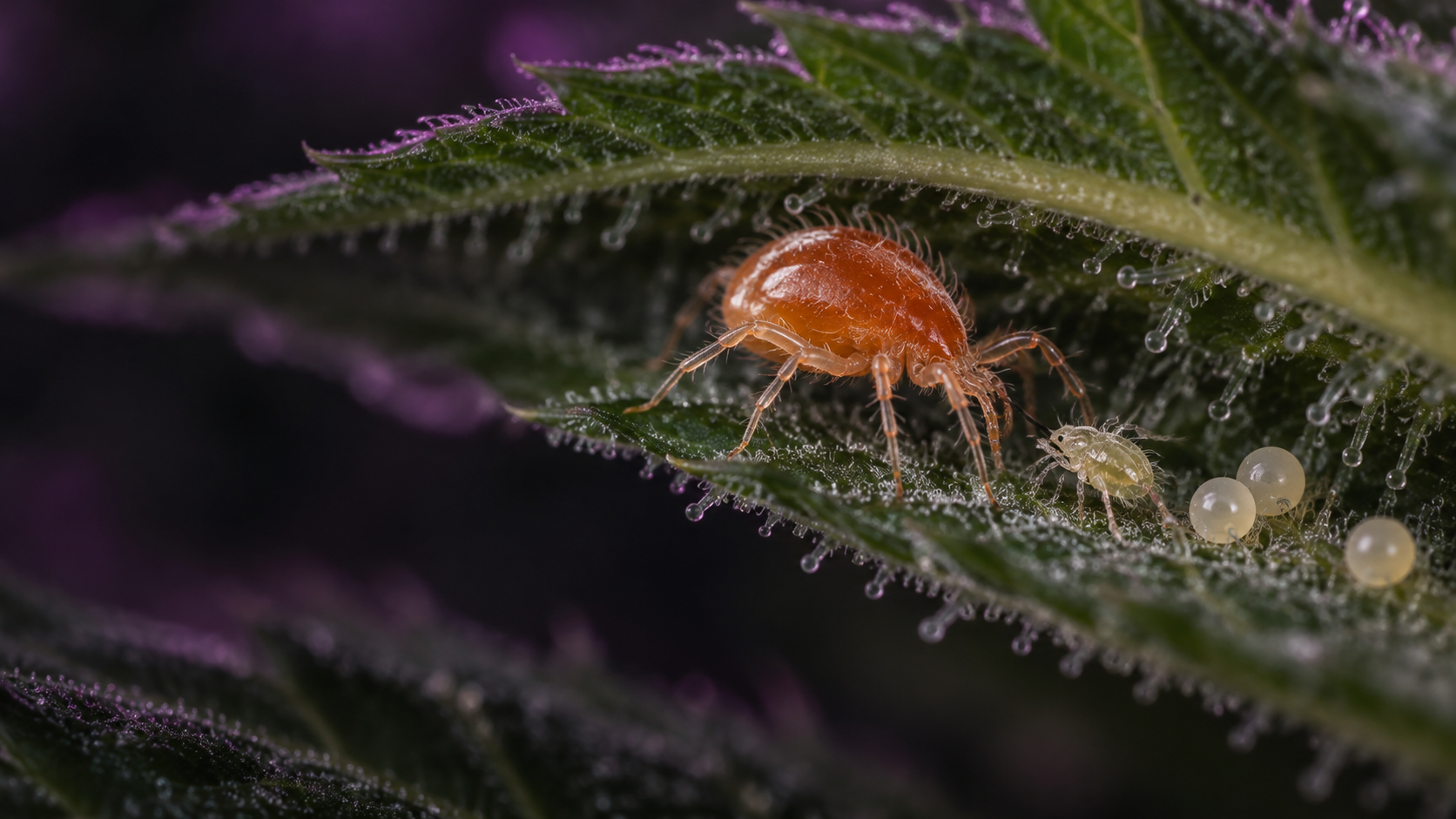
Different predatory mites for cannabis target different pests, life stages, and parts of the crop. There is no universal species.
Start by identifying the pest, then match the predator to the target and placement area. Canopy species may hunt spider mites or young larvae on cannabis plants, while a substrate-dwelling species can attack susceptible stages in the growing medium.
Before use, check crop conditions, product handling instructions, and pesticide compatibility. This guide explains how to make that match, place the mites correctly, and monitor whether the program is working.
What Are Predatory Mites and How Do They Help Cannabis?
Predatory mites are arachnids, not insects. They kill and consume other mites or small arthropods, making them useful biological control agents in cannabis cultivation. They are different from plant-feeding pests because they do not feed on the crop.
Some introductions are preventive or intended for early pest pressure. Others respond to an identified hotspot. A spider-mite specialist needs suitable prey, while generalists may persist on pollen or alternative food. Breeding systems use a separate food-mite population to support gradual movement into the canopy. Those differences matter more than looking for one “best” predator.
Which Predatory Mites Target Which Cannabis Pests?
Correct pest identification comes first. The practical questions are which life stage is vulnerable and whether it is on foliage or in the root zone. This comparison summarizes six predatory mites used or discussed in cannabis biological programs.
For spider mites, P. persimilis is the more specialized response, while N. californicus is commonly positioned for prevention or early pressure. Supplier guidance should confirm the actual target and program. On foliage, A. swirskii and N. cucumeris mainly attack young larvae. S. scimitus works in a different zone, feeding on pupal stages and fungus gnat larvae in the medium.
Broad mites and hemp russet mites are different pests, so efficacy claims should not move from one to the other. Cannabis guidance lists canopy predators to discuss for the first target, but that does not mean any generalist program automatically controls it. A. andersoni has been observed feeding on the russet pest, but effective biological control remains unestablished. Treat a suspected russet problem as a diagnosis and evidence question, not a promised predator target.
How to Release Predatory Mites in a Cannabis Grow
Begin by confirming the pest, life stage, and location. Mark representative plants and hotspots, then record a baseline count. Choose the species and formulation only after that assessment. Review recent spray history because pesticide residues can affect live predators even when no fresh application is planned.
Inspect the shipment when it arrives, follow its storage instructions, and apply promptly. Record the date, product, quantity, room, and placement points. Loose material may be sprinkled where the label directs or placed in release boxes so the carrier remains near the target. Account for gaps between plants that can limit movement through the canopy.
Breeding sachets work differently. They contain predators, food mites, and carrier that support gradual emergence. Hang an intact sachet in a sheltered canopy position. Factory-made exit holes already provide the route out, so do not open or empty the packet as loose material. Keep packets out of direct sunlight.
Apply S. scimitus on the growing medium, not on plastic covers. In flower, avoid depositing carrier into buds and confirm placement with the supplier and facility quality procedures. Rates, spacing, and repeat applications depend on crop size, pest density, formulation, and conditions. Use the supplier's current instructions rather than a universal mites-per-plant rate.
Match the Growing Environment to the Predator
The crop environment can determine whether a well-matched predator establishes. P. persimilis is sensitive to hot, dry conditions. N. californicus is relatively more tolerant, but low humidity and extreme heat can still reduce performance. A. swirskii is used under warmer conditions, while N. cucumeris has a different temperature and relative humidity profile. The substrate predator S. scimitus needs a suitable moist medium with usable pore space.
Check the canopy microclimate, not only the room sensor, and compare it with the exact product instructions. These product ranges are handling guidance, not Athena cannabis climate targets. Do not raise flowering-room humidity or overwater the root zone just to accommodate a predator. If crop requirements and predator preferences conflict, ask the supplier for a better species, formulation, or release strategy.
Coordinate Predatory Mites With Pesticides and IPM
Predatory mites for cannabis belong inside an integrated pest management plan that also uses sanitation, quarantine, correct identification, and removal of heavily affected material. They do not replace those practices.
Pesticides can harm predators through direct contact or residues. Oils, soaps, sulfur, and products described as “natural” are not automatically compatible. Before combining or sequencing treatments, check the exact active ingredient, formulation, dose, application method, beneficial species, and supplier side-effects guidance. There is no universal spray-to-release waiting period.
Biological compatibility and legal authorization are separate checks. Follow the current label and verify local cannabis rules for every pesticide. Do not combine multiple generalist canopy mites indiscriminately; suppliers may advise against specific pairings. A coordinated program should protect the introduction without compromising crop sanitation or regulatory requirements.
Monitor Results and Know When to Change the Plan
Return to the same marked plants and hotspots on a repeatable schedule. With magnification, record live pests by stage, predators, and fresh feeding injury. Sticky cards help track flying adult thrips or fungus gnats, but they do not measure spider mites or prove that larvae are being controlled on leaves.
Judge trends rather than a single sighting. Old stippling, bronzing, or distorted tissue will not disappear after a successful program, so look for whether new damage and live-pest counts are slowing. Also verify that the predator is present where it was placed.
If counts rise, the infestation spreads, identification remains uncertain, or flowers are being damaged, escalate promptly to an IPM adviser. Reassess the species match, product viability, placement, environmental conditions, and possible residues before simply adding more mites. Predatory mites work best as a measured process: identify, match, deploy, monitor, and adjust.
Subscribe to our newsletter
Athena® exists to support the modern grower, no matter the scale. Our core principle is to formulate products that improve quality, reduce costs and drive consistency. Athena® was born in the grow rooms of Los Angeles, California, where we are always in pursuit of the perfect run. As the weight of being a cultivator increases, we exist to make the complex simple.
Related posts
Predatory Mites for Cannabis: Pest Targets and Practical Use

Wet Trim vs Dry Trim: Understanding Cannabis Trimming Methods

What Is Cannabis Photoperiod? A Grower's Guide to Light Cycles

