




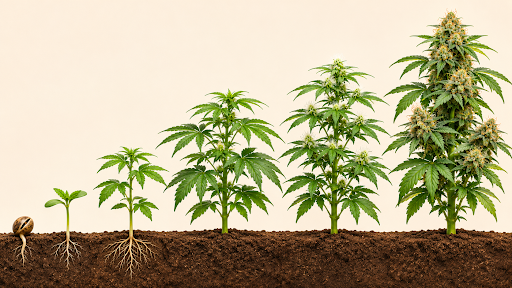
Every stage of cannabis growth builds on the one before it. Roots established early support vegetative growth. The structure developed in veg carries the flower load. By harvest, the plant is working with the foundation built throughout the cycle.
Understanding weed plant stages helps growers recognize what the plant is doing and whether development is progressing as expected. This guide breaks the cycle into six stages: germination, seedling, vegetative growth, pre-flowering, flowering, and maturity or harvest.
The timeline varies with genetics, plant health, environment, and cultivation method. Indoor photoperiod plants respond to grower-controlled light cycles, while outdoor plants respond more closely to seasonal changes. Autoflowering cultivars follow a different pattern, with reproductive growth driven mainly by age.
Before growing cannabis, check the home-cultivation rules where you live.
Understanding the Main Stages of Cannabis Growth
Cannabis development is continuous, so the boundaries between stages are not always exact. The six-stage breakdown below provides a practical way to identify the major changes from seed to harvest. Pre-flowering is the transition into early flower, and maturity is the final part of flowering. These are useful checkpoints within the cycle, rather than additional periods to add to the flowering timeline.
Timing matters, but plant development provides the context. A seed-grown photoperiod crop may take roughly three to five months or longer from seed to harvest. Outdoor plants can grow through much of a season. Autoflowering cultivars begin reproductive growth mainly in response to age, so their timeline is less dependent on a deliberate light-cycle change.
The ranges above are reference points. They do not mean every plant should reach the same stage on the same day. Count pre-flowering and final ripening within the flowering period rather than adding them as extra weeks.
Germination: Establishing the First Root
Germination begins when a viable seed absorbs water and resumes metabolic activity. The seed coat opens, and the first root, called the radicle, emerges. That root anchors the plant and begins the root system. The shoot then moves toward the surface.
Moisture, oxygen, temperature, and the condition of the growing medium all influence this first stage.
How long does germination take? Typically 24–72 hours, or one to three days, under suitable conditions. Seed age, genetics, storage, moisture, and temperature all affect timing. Older or less vigorous seeds may take longer.
What to look for: A firm, pale root without slime or fuzzy growth. The medium should remain moist and aerated. Prolonged saturation restricts oxygen and can interfere with early development.
Seedling Stage: Building Roots and True Leaves
The seedling stage begins when the shoot emerges and opens two rounded leaves called cotyledons. These embryonic leaves support early development while the first serrated true leaves expand.
During the next few weeks, the plant develops roots, adds leaf pairs, and builds a stronger stem. Aboveground growth may look modest while the root system is still establishing.
What to look for: A compact, upright plant producing new leaves. Stretching can indicate inadequate light, while drooping may reflect root zone moisture or environmental stress. Severe paling, spotting, curling, or a collapsed stem requires closer evaluation.
A symptom points to something worth checking. It does not identify the cause on its own.
How long does the seedling stage last? Often about two to three weeks, although established plants may begin rapid vegetative growth around the two-week mark. The transition is marked by several true leaves, an expanding root system, and steady new growth. Root establishment and plant development are more useful indicators of readiness than age alone.
Young plants have little buffer against extremes. Consistent moisture, moderate light, suitable temperature and humidity, gentle airflow, and clean tools support early growth. Direct wind, saturated or dry media, and abrupt environmental swings can slow development and increase disease risk.
Vegetative Stage: Building the Plant's Structure
During the vegetative stage, the plant builds the framework that will support flowering. Leaves expand, stems thicken, branches develop at the nodes, and roots occupy more of the growing medium.
What to look for: Active new growth, firm leaves, balanced branching, and an absence of persistent wilt or widespread discoloration.
Indoors, growers use the light cycle to maintain vegetative growth in photoperiod plants. An 18/6 cycle, with 18 hours of light and six hours of darkness, is the standard described in our vegetative-stage guide.
Light duration is only one part of the environment. Intensity, total daily light, temperature, water, nutrition, airflow, and root space all influence how the plant develops.
Outdoors, season and latitude influence the timeline. Long days favor vegetative growth, while decreasing day length signals reproductive development in photoperiod-sensitive plants. Cultivar and local conditions affect that response. Autoflowering genetics do not depend on the same seasonal cue.
How long does veg last? Typically two to four weeks indoors, depending on starting material, plant count, available space, and desired canopy size. Longer cycles may extend to four to six weeks or beyond. Outdoor plants may remain vegetative for months.
The transition becomes visible as reproductive structures develop. In photoperiod plants, shorter days provide the signal for that shift.
Pre-Flowering: Recognizing the Transition to Flower
Pre-flowering marks the transition from vegetative growth into flower. Early reproductive structures appear at the nodes, where branches meet the main stem. In an indoor flowering schedule, this transition is included in the first weeks of flower.
Female plants develop small bracts with paired hair-like stigmas. Male plants develop rounded pollen structures without those hairs. These early signs can be subtle, so identifying sex requires observing how structures develop across multiple nodes.
Pollination changes the female plant's development. Once a flower is fertilized, seed production begins. Growers producing unseeded flower separate pollen-producing plants, while breeders may retain them intentionally.
Cannabis can also express male and female reproductive structures on the same plant. Sex expression can vary with genetics and environmental conditions.
For indoor photoperiod plants, the switch to 12 hours of light and 12 hours of uninterrupted darkness marks the start of the flowering schedule. Visible signs often appear within one to two weeks. Autoflowering plants enter flower mainly in response to age rather than this light-cycle change.
The light-cycle change provides a signal. Visible reproductive growth confirms how the plant is responding.
Flowering Stage: Bud Development and Maturation
During flowering, female flower clusters develop at the nodes and shoot tips. Stigmas become more visible, and bracts build into the structures growers call buds. Early in flower, the plant may continue stretching before vertical growth slows and flower development becomes dominant.
Our flowering guide breaks this stage into three phases: Stretch, Bulk, and Ripen.
- Stretch (early flower): Stems continue extending as new floral sites develop. This transition is part of the flowering timeline.
- Bulk (mid flower): Vertical growth slows as buds expand and bracts swell. Resin glands called trichomes become more abundant across flowers and nearby small leaves.
- Ripen (late flower): Bud growth slows and the focus shifts toward maturity. Stigmas darken and recede, while trichome appearance continues to change.
Trichomes are the glands where cannabinoids and terpenes accumulate as flowers develop.
Environmental consistency remains important as flower structure becomes denser. Moisture can collect in areas that had open airflow during veg. Humid, stagnant pockets increase the risk of mold, including Botrytis.
Water availability, root zone conditions, light, and temperature also influence plant appearance. Keeping those conditions consistent makes it easier to distinguish normal maturation from stress.
How long does flowering take? Typically eight to ten weeks for many photoperiod cultivars, counted from the light-cycle change through final ripening. Faster cultivars may finish in seven to eight weeks, while some take twelve weeks or longer. Genetics and environment influence the timeline.
Maturity and Harvest: Evaluating the Whole Plant
Harvest readiness reflects flower maturity. Consistent with our harvest guide, trichome development is the primary visual reference, supported by bud structure, stigma changes, and overall plant condition. A predetermined week provides context, but it does not replace evaluating the crop.
Key maturity indicators include:
- Trichome development
- Bract development
- Stigma color and position
- The rate of new flower growth
- Overall plant health
- The cultivar's known development pattern
Trichome heads commonly progress from clear to cloudy and then amber as flowers mature. This progression helps growers evaluate the harvest window. Bud swelling, darkening and receding stigmas, and natural leaf fade provide supporting context. Trichome color remains a visual maturity indicator, rather than a direct measurement of cannabinoid concentration.
Evaluate flowers from representative canopy locations and compare development over time. Breeder information provides context, but the plant's condition still matters.
Reduced water use and natural leaf senescence may accompany maturity. Severe yellowing, wilting, or disease should not automatically be treated as a normal part of finishing.
Harvest ends the growing cycle and begins post-harvest handling. Drying and curing continue to influence moisture, aroma, and storage stability. They are separate processes with their own effect on final quality.
Summary
The main weed plant stages are germination, seedling growth, vegetative growth, pre-flowering, flowering, and maturity or harvest. Each phase supports the next, from the first root to the final development of the flowers.
Genetics, environment, and cultivation method influence the timeline. Records of age and light-cycle changes are useful, but they need to be considered alongside visible development and plant health.
Understanding what changes at each stage helps growers evaluate progress, recognize stress, and make more informed decisions throughout the cycle.
Subscribe to our newsletter
Athena® exists to support the modern grower, no matter the scale. Our core principle is to formulate products that improve quality, reduce costs and drive consistency. Athena® was born in the grow rooms of Los Angeles, California, where we are always in pursuit of the perfect run. As the weight of being a cultivator increases, we exist to make the complex simple.
Related posts
Weed Plant Stages: Understanding the Cannabis Growth Cycle From Seed to Harvest

Rockwool Cubes for Cannabis: A Complete Growing Guide

Grow Tent Setup Tips for Indoor Cannabis Growers

