


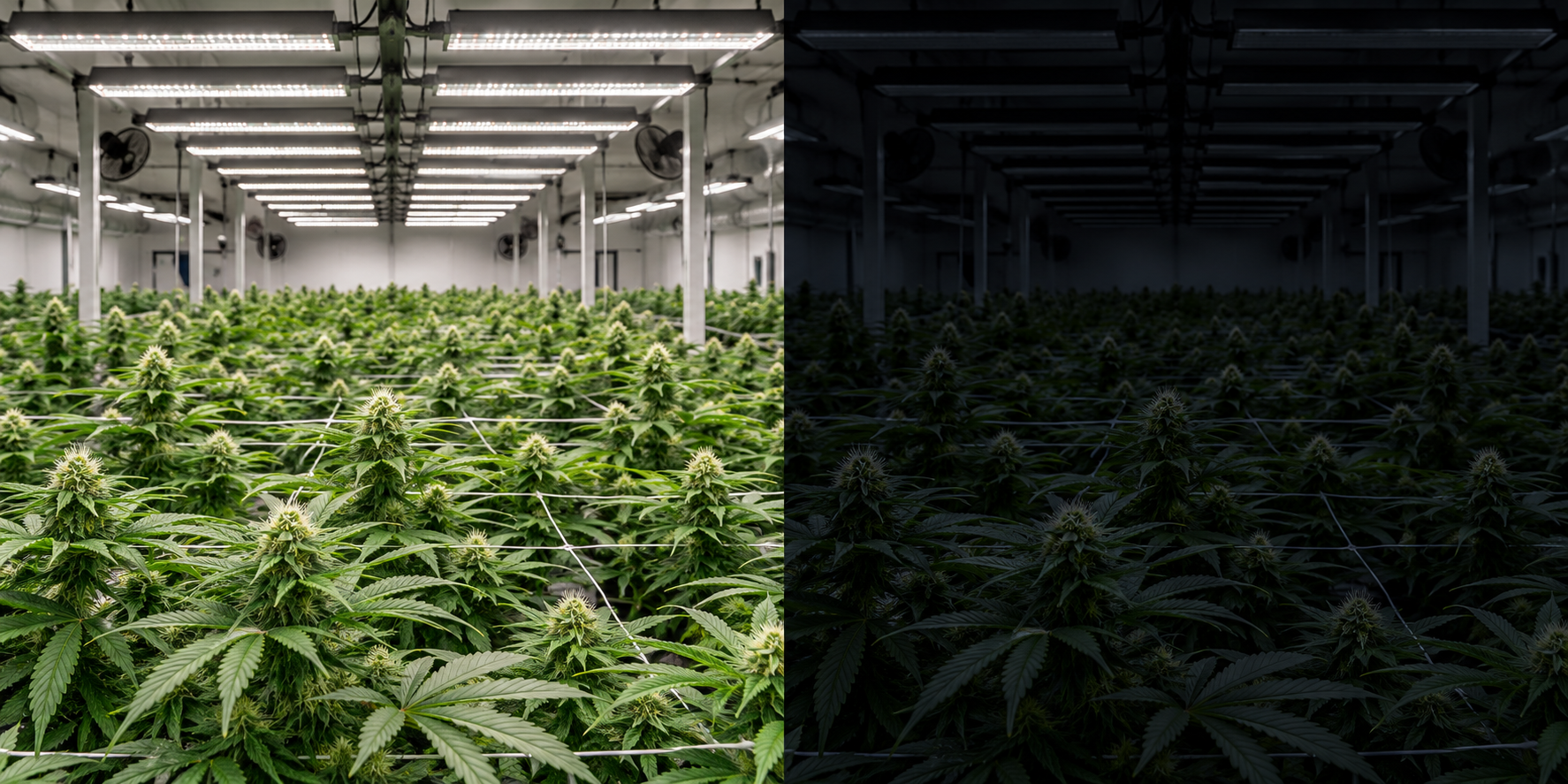
Photoperiod is the number of hours of light and darkness a plant receives in each 24-hour cycle. For photoperiod cannabis, it's the signal that connects the two biggest phases of the run: it keeps plants building structure in the vegetative stage and tells them when to shift into the flowering stage. Indoors, you control photoperiod with timers. Outdoors, you work with changing day length, twilight, latitude, season, and cultivar genetics.
The rule of thumb is simple: long days keep plants vegetative, while shorter days and longer, uninterrupted nights trigger flowering. Most growers run 18/6 (18 hours on, 6 hours off) in veg and flip to 12/12 for flower. Treat those schedules as dependable baselines, not fixed thresholds for every cultivar. This guide covers what photoperiod controls, how to run it indoors and outdoors, and how to troubleshoot when flowering doesn't go to plan. For the bigger picture on lighting, environment, and the rest of the grow, see How to Grow Cannabis.
1. What Does Photoperiod Mean?
Photoperiod describes duration, not brightness. A plant under 18 hours of dim light and a plant under 18 hours of intense light share the same photoperiod, but they don't receive the same amount of usable light. Two measurements cover the intensity side:
- PPFD (photosynthetic photon flux density): Light intensity at the canopy, measured in µmol/m²/s.
- DLI (daily light integral): Total light delivered per day, measured in mol/m²/day. DLI combines PPFD with hours of light.
At a constant canopy PPFD of 600 µmol/m²/s, here's how photoperiod changes DLI:
- 12 hours: 25.9 mol/m²/day
- 13 hours: 28.1 mol/m²/day
- 18 hours: 38.9 mol/m²/day
- 24 hours: 51.8 mol/m²/day
Grower Tip: Change the timer and you change daily light delivery, unless you also adjust intensity. The longest photoperiod, including 24/0, isn't automatically the best one. Plant development, cultivar response, electrical load, climate control, and target DLI all have to work together.
2. How Cannabis Responds to Day Length and Darkness
Most photoperiod cannabis is a short-day plant: it moves into flower as days shorten. In the grow room, the uninterrupted dark period matters just as much as the length of the day. The plant reads the cycle through light-sensitive signaling, so an inconsistent night sends a different signal than a clean, repeatable schedule.
Cultivar Response Varies
Not every cultivar needs a 12-hour day to flower. Some indoor drug-type cultivars start flowering with up to 14 hours of light, though timing and early flower development differ from one to the next. Some will even start under 15 hours, but the flowers don't continue developing normally. That's why 12/12 is the standard: it's a safe operating baseline, not proof that every cultivar has the same critical day length.
Outdoor and Hemp Genetics Add More Variation
Hemp cultivars differ widely in critical photoperiod, flowering delay, and sensitivity, and some respond to day-length changes as small as 15 minutes. Hemp results aren't production instructions for high-THC cultivars, but the takeaway carries over: genetics and source matter when you read a light schedule.
3. Common Cannabis Light Cycles by Growth Stage
A stable schedule is worth more than chasing small theoretical gains. The cycles below are the baselines most indoor growers run. Dial them in for your own cultivars, room design, light intensity, environmental capacity, and production goals.
Vegetative Growth: Why 18/6 Is the Baseline
An 18/6 cycle gives photoperiod plants a long day that keeps them vegetative while preserving a defined dark period. 24 hours on is common for clones, and 18/6 remains the veg baseline. Veg propagation mothers can be used at 18/6 to 24 hours of light, and it is important to understand the DLI between those timeframes. Some growers also run 24/0 (continuous light) through veg, not just for clones. It's a legitimate long-day option, but more hours aren't automatically more efficient.
This is where DLI matters most. At the same canopy PPFD, going from 18 to 24 hours raises DLI by about one-third. At 600 µmol/m²/s, 18 hours delivers about 38.9 mol/m²/day and 24 hours delivers about 51.8 mol/m²/day. Heat load and electrical load climb with the longer photoperiod too. For full veg targets, including PPFD, temperature, RH, and VPD, see our Cannabis Veg Stage guide.
Grower Tip: If you run 24/0, dial intensity down so you still hit your target DLI instead of stacking extra hours on top of an already high PPFD. Evaluate the whole system, not just the timer.
Flowering: Why 12/12 Is the Baseline
Twelve hours of light followed by 12 hours of darkness sends a strong, repeatable flowering signal across most photoperiod cultivars. Certain cultivars can start flowering and yield well on 13- or 14-hour days, but the response isn't uniform. Treat a longer flowering day as a controlled cultivar trial, not a drop-in upgrade for an untested room.
What Happens After the Flip
The flip doesn't produce mature flowers overnight. Plants first need repeated short days, then development shifts at the shoot tip. Stretch, changes in branching, and the first pistils (stigmas) show up over time, with timing driven by cultivar, plant maturity, and environment. Some genotypes need at least three consecutive short days before flower development starts. In practice, first pistils typically appear within 1–2 weeks of the flip, as covered in our Cannabis Flowering Stage guide. Read these as signs of progress, not a countdown that fits every room.
Grower Tip: After the flip, hold temperature, RH, and VPD steady so you can read the crop:
- Record the switch date.
- Confirm every lighting zone runs the same program.
- Inspect comparable plants at consistent intervals.
Good records make it easier to tell normal cultivar timing apart from a controller error or a local light leak.
Longer Flowering Days: Yield vs. Chemistry
Longer days can shift both yield and chemistry. In some medicinal cannabis lines, flowering under 14 hours of light produced the most flower biomass, but high-THC lines can also show lower THC under a static 14-hour day. Other cultivars have done better on 13-hour days. Bottom line: validate carefully before you change a schedule.
4. Photoperiod vs. Autoflowering Cannabis
- Photoperiod cultivars: Depend on day-length signals to move from vegetative growth into mature flowering.
- Autoflowering (day-neutral) cultivars: Carry inherited traits that reduce this dependence, so flowering is driven more by plant age than by a flip to 12/12.
That doesn't make the light schedule irrelevant for autos. Day length still changes DLI, energy use, temperature, and the time available for photosynthesis. The difference is genetic, not just grower shorthand. Manage any cultivar sold as an autoflower based on its verified genetics and how it actually develops in your room, rather than assuming all cannabis responds the same way.
5. Managing Photoperiod Indoors
Indoors, photoperiod management comes down to repeatability.
- Lock in your timers: Program lighting controllers to one facility time standard, verify the actual on/off events, and document every intentional schedule change. After maintenance or a power interruption, confirm clocks, controllers, and backup systems returned to the intended program.
- Protect the dark period: Walk rooms during lights-off and look for indicator lamps, door gaps, failed blackout material, controller screens, or light from adjacent production areas.
- Time transfers to the room's cycle: When moving rooted plants into a flowering room, line up transfer timing with that room's light cycle so plants don't get an accidental extended day or interrupted night.
- Validate lights-off access: If you have to enter a room during darkness, use procedures and work lights validated for your facility. Don't assume a colored work light is safe everywhere.
Grower Tip: There's no single "safe" light-leak level for every cultivar, spectrum, duration, and timing. Very low, localized stray light has delayed flowering in at least one drug-type cultivar, so aim for a consistently dark night instead of guessing at an allowance. Light leaks are also a stress trigger for hermaphrodites, as covered in our Cannabis Flowering Stage guide.
6. Photoperiod Considerations for Outdoor Growers
Outdoor plants respond to their local light environment, not just the calendar. Latitude changes seasonal day length, while buildings, tree lines, slope, and greenhouse coverings change the light plants actually see. Twilight counts too: in hemp, civil-twilight light contributes to flowering response.
That makes cultivar selection central to outdoor planning. A cultivar adapted to one latitude may flower too early, too late, or unevenly somewhere else.
- Start with breeder information: Use it as a baseline, then compare it with your local grow records.
- Track by cultivar: Log the first reproductive signs for each cultivar, every season.
- Control greenhouse day length: Supplemental day-extension lighting holds long-day conditions, and blackout systems create a shorter day. Both need uniform coverage and reliable controls.
7. Troubleshooting Flowering and Light-Cycle Problems
When flowering is late or uneven, check the system before you change nutrition or make aggressive crop adjustments. A photoperiod problem can look like a genetic or developmental delay, and several causes can stack up at once.
Revegetation: When Flowering Plants Return to Long Days
Revegetation is a real developmental response. Put flowering female plants back on long days and you can see longer internodes, loose or disrupted flower development, and a return to long-day growth patterns. Plants often need continued short days to keep normal flower structure, and exact timing varies by cultivar.
8. Common Questions Growers Ask About Photoperiod
Do I have to run 18/6 in veg? No, but 18/6 is the veg baseline because it keeps photoperiod plants vegetative while preserving a defined dark period. Some facilities run 24/0 in veg, not just for clones. Continuous light still keeps plants vegetative, but at the same PPFD it raises DLI by about 33% versus 18 hours, along with heat and electrical load. Many growers who run 24/0 dial intensity down to stay on a target DLI.
Can cannabis flower with more than 12 hours of light? Some cultivars start flowering and yield well on 13- or 14-hour days, but responses vary, including lower THC in some high-THC lines under 14 hours. Run a controlled cultivar trial before changing a whole room.
How long after the flip does flowering start? Plants need repeated short days before development shifts. First pistils typically appear within 1–2 weeks of switching to 12/12, depending on cultivar, plant maturity, and environment.
Do autoflowers need 12/12? No. Autoflowers flower based on plant age more than day length, though the light schedule still affects DLI, energy use, and temperature.
Do small light leaks matter? Yes, they can. There's no universal safe level, and very low stray light has delayed flowering in at least one drug-type cultivar. Aim for a consistently dark night.
9. Key Takeaways for Managing Cannabis Photoperiod
Getting photoperiod right sets the timing for your entire run.
- Photoperiod is a signal, not just a timer setting: Long days hold photoperiod cannabis in veg; shorter days and uninterrupted nights trigger flower.
- Start with 18/6 and 12/12: 18/6 is the veg baseline and 12/12 is the flowering standard because both are repeatable and broadly effective.
- Run 24/0 with your DLI in mind: Continuous light works for clones and veg, but at the same PPFD it delivers about one-third more light per day. Dial intensity to hit your target.
- Respect genetics: Some cultivars flower on days longer than 12 hours, but timing, structure, yield, and cannabinoid response can differ.
- Protect the dark period: Keep timers reliable and rooms truly dark during lights-off.
- Trial before you change: Validate any nonstandard flowering schedule with a controlled, cultivar-specific trial.
Get the light cycle right, keep it consistent, and the structure you build in veg carries cleanly into flower.
Subscribe to our newsletter
Athena® exists to support the modern grower, no matter the scale. Our core principle is to formulate products that improve quality, reduce costs and drive consistency. Athena® was born in the grow rooms of Los Angeles, California, where we are always in pursuit of the perfect run. As the weight of being a cultivator increases, we exist to make the complex simple.
Related posts
What Is Cannabis Photoperiod? A Grower's Guide to Light Cycles
Cal-Mag Deficiency in Cannabis: How to Diagnose Calcium and Magnesium Deficiencies
What Is VPD? Understanding Vapor Pressure Deficit for Cannabis Growing

