




Vapor pressure deficit (VPD) describes the drying demand of the air. In cannabis cultivation, it helps explain how temperature and humidity influence water loss from leaves and the demand placed on the root system.
For growers, VPD is most useful when it is connected to what the crop is doing. Read it alongside leaf temperature, water use, and root zone conditions to understand whether irrigation and the environment are working together.
What Is VPD (Vapor Pressure Deficit)?
VPD measures atmospheric drying potential in kilopascals (kPa). Air VPD is the difference between saturation vapor pressure at the air temperature and the actual vapor pressure in the air. Leaf-to-air VPD uses leaf temperature for the saturation value, making it more relevant to the moisture gradient driving transpiration.
When the air is close to saturation, the difference in vapor pressure is small and VPD is low. When the air contains much less moisture than it could hold, the difference is larger and VPD is high.
For a cannabis plant, this difference matters because water is constantly moving from the growing medium, through the roots and stems, and out through microscopic openings in the leaves called stomata. VPD helps describe the atmospheric conditions influencing that movement. It does not directly measure how much a plant is transpiring, but it helps explain the demand placed on the leaf.
How Temperature and Humidity Affect VPD
Air temperature changes the amount of moisture the air can hold. Warm air can hold more moisture before reaching saturation than cool air. As a result, the same relative humidity can create a different VPD at a different temperature.
Saturation vapor pressure is the pressure created by water vapor when the air is fully saturated at a particular temperature. Actual vapor pressure reflects the water vapor currently present. VPD measures the difference between those two values.
Leaf temperature adds another layer. Water evaporates from the moist interior of a leaf into the surrounding air, so the most plant-relevant calculation compares saturation vapor pressure at the leaf surface with the actual vapor pressure of the room. Under LED lighting, leaves may run cooler than the surrounding air because the fixtures deliver less radiant heat than high-pressure sodium lighting. A room calculation based only on air temperature can therefore overstate the leaf VPD.
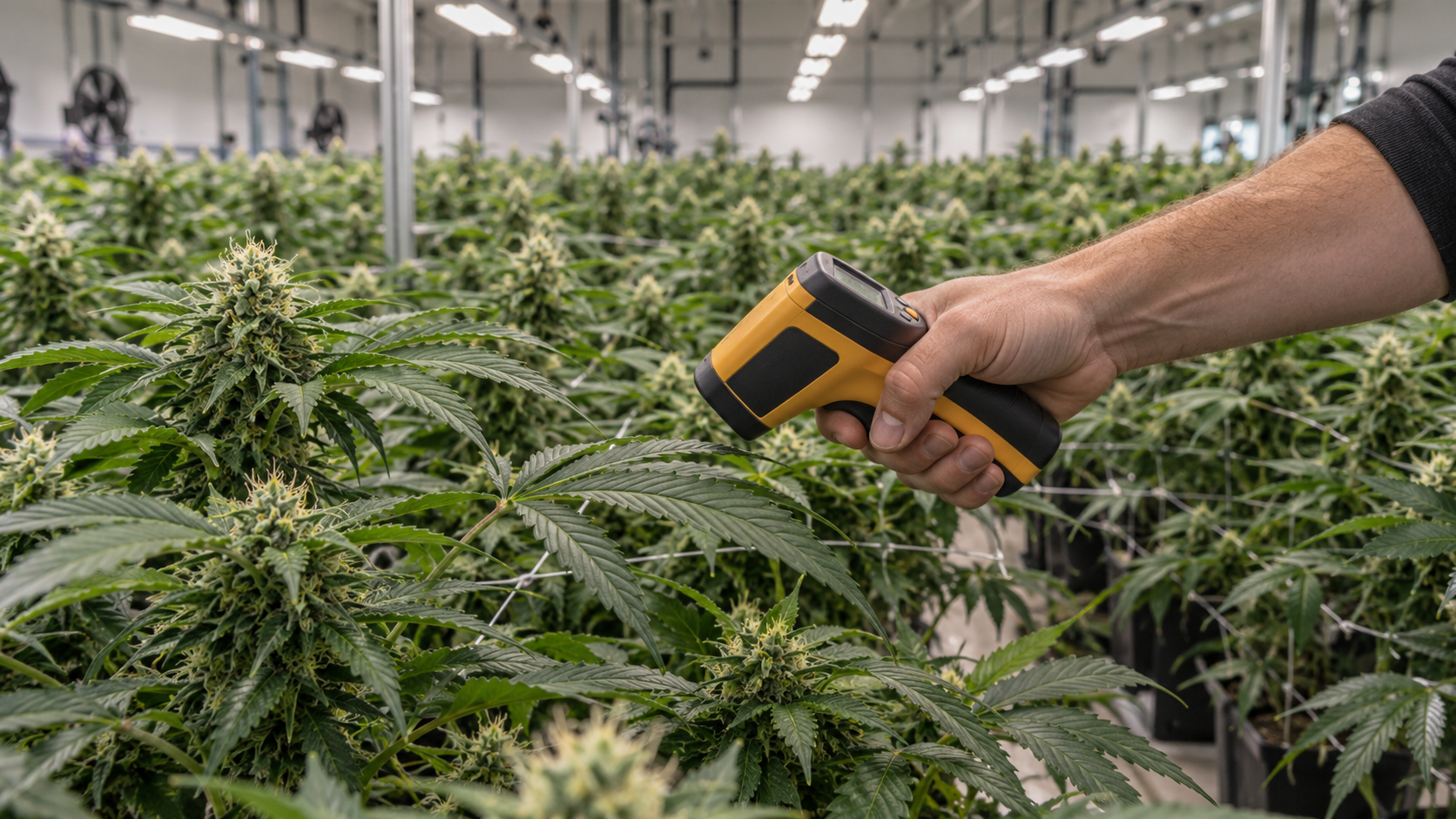
That is why reliable temperature readings matter. A shaded air thermometer or calibrated sensor measures the room, while an infrared thermometer or thermal sensor can help estimate leaf temperature at representative points across the canopy.
VPD vs. Relative Humidity
Relative humidity describes the amount of moisture currently in the air relative to the maximum amount the air can hold at that temperature. VPD describes the remaining drying potential.
Imagine a grow tent at 75°F and 60% relative humidity. If the temperature rises to 82°F while the amount of moisture stays similar, relative humidity falls because the warmer air can hold more moisture. VPD increases, so the atmosphere places greater drying demand on the plants—even though no water was removed from the air.
Relative humidity is still useful, but it must be interpreted with temperature. VPD combines humidity and temperature into a value that more directly describes the plant-to-air moisture gradient.
How VPD Affects Transpiration and Plant Growth
Cannabis plants transpire by releasing water vapor through their stomata. This water loss helps move water and dissolved nutrients upward through the xylem, cool the leaf, and support normal plant development. Environmental conditions strongly influence the transpiration rate.
At a moderate VPD, the atmosphere provides enough drying demand to support steady water movement without overwhelming the plant. If demand becomes excessive, a plant may be unable to replace water as quickly as it loses it. It may close its stomata to conserve water, which can also restrict carbon dioxide exchange and photosynthesis. If drying demand is very low, transpiration may slow and the room may remain persistently humid.
VPD is important because it gives growers a useful framework for connecting the environment with plant behavior, irrigation, and nutrient uptake. It is not the only factor controlling plant growth. Root health, growing medium water content, light intensity, airflow, nutrition, cultivar, and crop load all influence how a plant responds.
How to Calculate and Measure VPD
VPD can be calculated from a few measurements:
- Air temperature: Used to calculate saturation vapor pressure.
- Relative humidity: Used with air temperature to estimate actual vapor pressure.
- Leaf temperature: Needed for a more plant-relevant leaf-to-air VPD.
Once those values are available, a calculator compares saturation vapor pressure with actual vapor pressure and reports the difference in kPa.
When using a VPD calculator:
- Check whether it assumes leaf temperature equals air temperature.
- Enter a measured leaf temperature or leaf-to-air offset when the tool allows it.
- Use representative, calibrated sensors instead of a reading near a humidifier, supply duct, wall, or light.
- Log measurements over time rather than reacting to a single reading.
What Is a Good VPD for Cannabis Plants?
There is no single ideal VPD for every cannabis plant. Useful targets depend on the stage of growth, cultivar, root development, lighting, irrigation capacity, and the plant’s ability to keep pace with atmospheric demand. Growers should work within ranges and confirm performance by watching the crop.
Common starting ranges for indoor cannabis are approximately:
- Seedlings and newly rooted clones: 0.4–0.8 kPa
- Established vegetative growth: 0.8–1.2 kPa
- Early to mid-flower: 1.0–1.4 kPa
- Late flower: 1.2–1.5 kPa
These are reference ranges, not guarantees or hard boundaries. Young plants have small root systems and limited capacity to replace water, so they are commonly managed at lower VPD levels. Established plants can often tolerate higher VPD as root systems and canopies develop.
For late flowering, some growers operate near the upper end of their established range to help control humidity around dense flowers. The best VPD still depends on leaf temperature, irrigation, cultivar response, and facility risk. Increasing VPD does not replace airflow, sanitation, canopy management, or dehumidification.
How to Use a VPD Chart for Cannabis
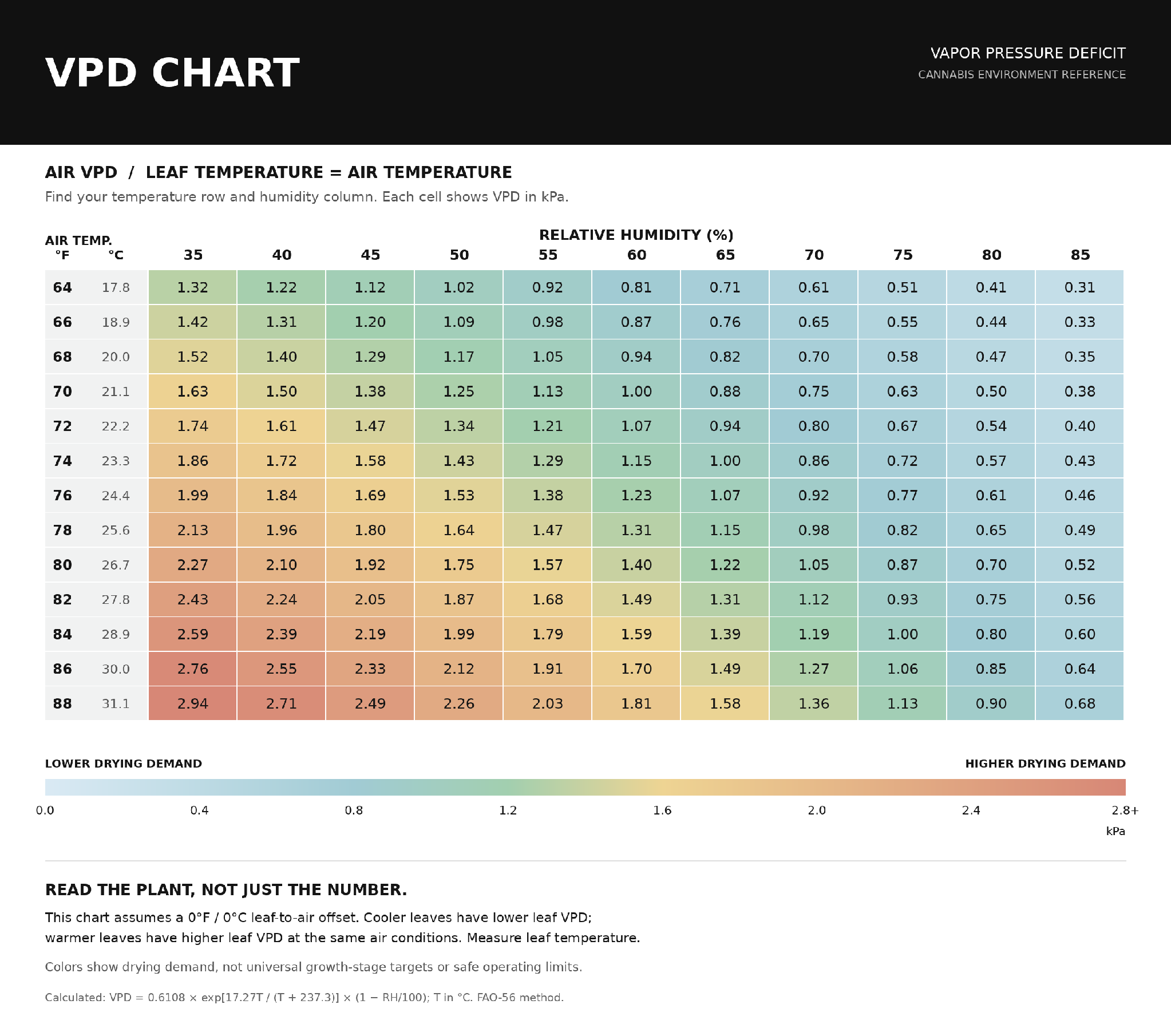
The chart above is an air-VPD chart calculated from air temperature and relative humidity. It assumes leaf surface temperature equals air temperature (a 0°F/0°C leaf-to-air offset). Under that assumption, the air-VPD and leaf-to-air VPD values are the same. Find the current air temperature on one axis, find relative humidity on the other, and read the value where the two meet.
If the measured leaf temperature differs from air temperature, the chart does not show the actual leaf-to-air VPD. Cooler leaves produce a lower leaf-to-air VPD than the value shown, while warmer leaves produce a higher value. Use a calculator or chart that accepts measured leaf temperature or a leaf-temperature offset.
The color gradient shows drying demand, not universal growth-stage targets or safe operating limits. Check the chart's assumptions, then compare the reading with plant posture, water use, substrate conditions, and crop health. A value inside a preferred range does not confirm that the entire growing system is working correctly.
How Do You Adjust VPD in a Cannabis Grow Environment?
Growers adjust VPD by changing temperature, relative humidity, or both. In general:
- Raise VPD: Increase temperature or reduce relative humidity.
- Lower VPD: Decrease temperature or increase relative humidity.
- Evaluate HVAC effects: Dehumidification, humidification, ventilation, and cooling all influence the final result.
- Adjust gradually: Temperature changes also affect metabolism, water use, cooling demand, and dew-point risk.
- Use airflow for uniformity: Airflow does not directly change room VPD, but it reduces stagnant boundary layers and helps create more uniform canopy conditions.
- Map the room: Compare intake and exhaust areas, canopy heights, corners, and zones near equipment instead of relying on one sensor.
Stable, uniform conditions are generally more useful than repeatedly chasing a narrow VPD number.
Does VPD Matter at Night?
Yes. When lights turn off, leaf and air temperatures often fall while relative humidity rises. That shift can rapidly lower nighttime VPD and move cold surfaces toward the dew point. Condensation may form even when the daytime room looked well controlled.
Monitor VPD at night, especially during the first hours after lights-off and around irrigation events. Nighttime VPD does not need to match daytime VPD exactly, but temperature and humidity changes should remain controlled enough to avoid condensation and prolonged high-humidity pockets within the canopy.
What Happens When VPD Is Too High or Too Low?
VPD extremes can create recognizable patterns, but the symptoms are not specific to VPD.
When VPD is too high:
- Plants may use substrate water faster than expected.
- Leaves may lose turgor, curl, or cup.
- Stomata may close if water loss exceeds the plant’s ability to replace it.
- Root-zone salts may concentrate faster if irrigation does not keep pace with water use.
When VPD is too low:
- Transpiration may slow.
- Leaves and canopy surfaces may stay wet longer.
- Condensation and disease risk can increase in persistently humid areas.
- Water-driven movement of some nutrients may slow.
Similar symptoms can also come from lighting, irrigation, unhealthy roots, nutrient imbalance, temperature stress, or poor airflow. Review the full system before changing setpoints.
Managing VPD for Consistent Plant Growth
Use VPD as a diagnostic framework, not a stand-alone target. For consistent plant growth:
- Measure air temperature, relative humidity, and representative leaf temperature reliably.
- Compare VPD with plant water use, dryback, substrate EC, and crop posture.
- Make small environmental changes and give the crop time to respond.
- Keep atmospheric demand aligned with the plant’s ability to take up water.
The goal is a stable growing environment that supports healthy growth throughout the cycle.
Subscribe to our newsletter
Athena® exists to support the modern grower, no matter the scale. Our core principle is to formulate products that improve quality, reduce costs and drive consistency. Athena® was born in the grow rooms of Los Angeles, California, where we are always in pursuit of the perfect run. As the weight of being a cultivator increases, we exist to make the complex simple.
Related posts

Wet Trim vs Dry Trim: Understanding Cannabis Trimming Methods
What Is Cannabis Photoperiod? A Grower's Guide to Light Cycles
Cal-Mag Deficiency in Cannabis: How to Diagnose Calcium and Magnesium Deficiencies

