




Potassium supports how cannabis plants regulate water, use energy, and move sugars through the plant. When the supply falls short, growth can slow and leaves may begin yellowing or developing brown edges. Those symptoms often lead growers to increase feed strength before checking what is happening in the root zone.
The first question is whether the plant needs more potassium or is struggling to absorb what is already there. Damaged roots, salt accumulation, and an imbalanced feeding program can produce similar symptoms but require different corrections.
Managing potassium for cannabis plants starts with understanding that distinction. A consistent supply supports development from early growth through flower, while excess can interfere with other nutrients. The goal is to maintain an appropriate balance and respond to the cause of a problem before changing the recipe.
The Role of Potassium in Cannabis Growth
Potassium is an essential macronutrient, represented by K on fertilizer labels. Alongside nitrogen and phosphorus, it is needed in relatively large amounts. Roots absorb it as dissolved potassium ions, or K+, from the water surrounding them.
Inside the plant, potassium helps regulate water movement and maintain cell pressure. It supports osmosis, the movement of water across cell membranes, and helps guard cells open and close stomata. These small leaf pores allow gas exchange while regulating water loss.
Potassium also activates enzymes involved in metabolism and supports photosynthesis, protein production, and the movement of carbohydrates. Sugars produced in the leaves must reach growing roots, shoots, and flowers. These processes connect potassium nutrition with overall plant development.
Unlike calcium, which contributes directly to cell wall structure, potassium primarily works in dissolved form inside cells. Its role is spread across several functions, so an inadequate supply can affect the whole plant rather than producing one unmistakable symptom.
Flower development: Adequate potassium supports normal flowering, but adding more after the plant's needs are met does not guarantee larger buds, greater potency, or improved quality. Cannabis research has shown that cultivars can respond differently to the same supply. Evaluate the complete feeding program and crop response before increasing concentration.
Recognizing Potassium Deficiency and Excess
Potassium is mobile within the plant. When supply becomes limited, it can be redistributed from older tissue to developing growth. Older or lower leaves therefore often show signs of deficiency first, although the pattern can vary with cultivar, growth stage, and the severity of the shortage.
Common signs of potassium deficiency include:
- Yellowing: Discoloration may begin on older leaves and extend along the margins.
- Leaf-edge damage: Tips and edges may turn brown or appear scorched.
- Reduced vigor: Growth may slow and foliage may look stressed.
- Dead tissue: Damaged areas can expand as the problem progresses.
In flowering plants, inspect both fan leaves and the smaller leaves near flowers. A fading leaf or browned margin does not confirm a potassium deficiency. Leaf symptoms and tissue test results do not always align, so visual observations need context.
Other deficiencies: Magnesium deficiencies often cause yellowing between the veins of older leaves. Calcium deficiency more commonly affects young or developing tissue, while iron deficiency often appears as yellowing between the veins of the youngest leaves. These patterns help narrow the investigation, but several problems can occur together.
Nutrient burn: Excessive fertilizer can also damage leaf tips and margins. If symptoms appeared after increasing feed strength or adding a supplement, review that change before applying more potassium.
Excess potassium: Too much can interfere with calcium and magnesium nutrition. What growers describe as potassium toxicity symptoms may actually be signs of a secondary deficiency or increased salt concentration. A photograph alone cannot distinguish these conditions reliably.
Compare affected plants with healthy plants receiving the same feed. One struggling container suggests checking local delivery and drainage. Symptoms across an entire irrigation zone make a shared input or environmental change worth investigating.
What Causes Potassium Deficiency
A true shortage can develop when the feeding program does not provide enough potassium. A mixing error, excessive dilution, or an unsuitable fertilizer may leave the crop without an adequate supply. However, the presence of potassium in a recipe does not guarantee healthy uptake.
Root zone conditions: Roots need access to both water and oxygen. Persistent saturation, poor drainage, or root damage can limit uptake even when the solution contains the required nutrients. Excessive drying can also interrupt water movement and concentrate salts around the roots.
Salt accumulation: As plants remove water, dissolved salts can become more concentrated in the growing medium. Irrigation practices and fertilizer concentration need to be considered together. Increasing feed strength can worsen a problem that began with uneven wetting or insufficient drainage.
Nutrient interactions: Potassium competes with other positively charged ions, including calcium and magnesium. A substantial imbalance can affect uptake. Review the contribution of all products in the program, including supplements, rather than looking at the base fertilizer alone.
pH and water quality: Check root zone pH against the recommendations for the growing medium. Interpret the reading alongside water chemistry, root condition, and the rest of the feeding program. A single reading does not establish potassium lockout.
Soil also contains potassium in different forms. Some is held within minerals and is not immediately available to roots. A large total supply does not necessarily mean the plant can access enough at the time it needs it.
Correcting Potassium Problems in the Root Zone
Start by confirming what changed before the symptoms appeared. Record the feed recipe, irrigation pattern, root zone measurements, and location of affected plants. A scorched leaf after a feeding increase deserves a different investigation from one on a plant receiving an accidentally diluted mix.
- Check the measurements. Calibrate pH and electrical conductivity meters. Electrical conductivity, or EC, indicates overall dissolved salt concentration; it does not identify individual nutrients.
- Review the recipe. Confirm dilution, component amounts, mixing order, and recent additions. Include supplements and pH-adjusting products.
- Inspect the root zone. Check drainage, moisture distribution, root condition, and solution delivery. Compare affected and healthy containers.
- Correct the confirmed cause. Resolve mixing, irrigation, or root problems before deciding whether the crop needs additional potassium.
When testing the medium, use a sampling method appropriate to the system. Field soil and soilless media tests use different methods and cannot be interpreted interchangeably. Ask the laboratory how to collect representative samples and provide the crop stage, feeding history, and symptoms.
If a shortage is confirmed, adjust potassium within the complete feeding program. Account for the other elements supplied by the fertilizer and monitor the result. A large potassium boost based only on leaf appearance can turn one imbalance into another.
If excess is confirmed, identify duplicated or unnecessary inputs and correct the recipe. The response will depend on the system; a reservoir correction and a soil amendment problem require different approaches. Automatically adding calcium or magnesium can increase salt concentration further without resolving the original cause.
After a correction, watch whether damage stops spreading and subsequent growth develops normally. Dead tissue will not turn green again. Keep a record of what changed so the next decision is based on plant response rather than the continued appearance of an already damaged leaf.
Choosing Sources of Potassium
The appropriate potassium fertilizer depends on the growing medium, existing recipe, water chemistry, and the other elements the crop needs. Compare the complete composition of each source before adding it to the program.
Potassium sulfate: Supplies potassium and sulfur without nitrogen. Both contributions need to be included when evaluating the final recipe.
Potassium nitrate: Supplies potassium and nitrogen together. It may fit a program that requires both, but it also increases nitrogen when the goal might be to change potassium alone.
Potassium chloride: Supplies potassium with chloride. Consider the water source and total salt load before choosing it.
Potash is a broad fertilizer term associated with potassium-containing materials and reporting conventions. Products described as potash are not necessarily interchangeable. Check the actual ingredients, solubility, and suitability for the growing system.
Compost and composted plant materials can contribute potassium in soil-based programs, but their nutrient content varies. There is no universally best organic source for cannabis. The right choice depends on the medium's existing fertility and the predictability of the amendment.
Banana-derived materials are often discussed as a source, but homemade banana water is not a dependable, measured correction. Composting food scraps is more useful than relying on an untested liquid to address an active shortage.
Wood ash contains potassium but can substantially raise pH and introduce soluble salts. Test soil before considering it. Its variable composition makes it poorly suited to an improvised correction in a tightly managed container program. An organic source still needs to fit the crop and growing medium.
Managing Potassium Through Each Growth Stage
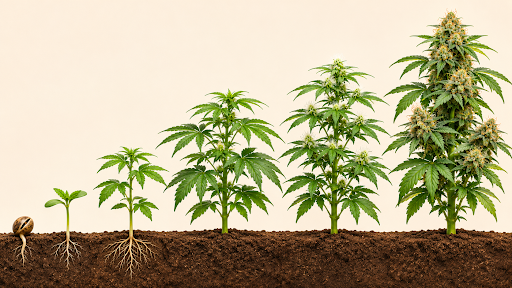
Cannabis plants need potassium throughout development, but there is no single feeding concentration that suits every cultivar and system. Plant size, medium, irrigation, water chemistry, and the rest of the recipe influence how the crop should be managed.
Early growth: Use a complete program appropriate to small plants and developing roots. Maintain even moisture and drainage while the root system establishes. A young plant showing stress needs an assessment of its growing conditions before a stronger feed.
Vegetative growth: As the canopy expands, water use and the total amount of nutrients consumed can increase. That does not automatically mean solution concentration should increase at the same rate. Evaluate plant development alongside irrigation and root zone measurements.
Flowering: Maintain an adequate supply while evaluating the entire recipe. Entering flower does not justify unlimited potassium. The plant still depends on functioning roots, healthy foliage, and an appropriate balance of nitrogen, phosphorus, calcium, magnesium, and other essential elements.
Our new product, Athena Proper, fits within a coordinated flowering program for Athena Pro Line and Blended Line. It supplies phosphorus, potassium, humic and fulvic acids, and micronutrients. Within its feeding program, Proper partially replaces base nutrients to adjust phosphorus and potassium while progressively reducing nitrogen as the crop matures.
Follow the matching Athena feeding program, including the base nutrient adjustments, when incorporating Proper. It is intended for hydroponic use. Evaluate it as part of the planned flowering recipe rather than automatically adding it in response to leaf damage.
Across each stage, consistency helps prevent problems. Monitor water quality, root zone pH, EC, drainage, and crop development. Collect measurements using the same method and timing so trends are useful. Review all inputs when changing the recipe and record how the plants respond.
Summary
Potassium supports water balance, enzyme activity, and normal cannabis growth. Both a shortage and an excessive supply can create problems, and their symptoms can overlap with nutrient burn or other deficiencies.
Successful management of potassium for cannabis plants depends on availability and balance. Check the roots, irrigation, water quality, and complete feeding program before making a correction. Maintain a consistent supply through each growth stage, make measured changes when needed, and use plant response to guide the next decision.
Subscribe to our newsletter
Athena® exists to support the modern grower, no matter the scale. Our core principle is to formulate products that improve quality, reduce costs and drive consistency. Athena® was born in the grow rooms of Los Angeles, California, where we are always in pursuit of the perfect run. As the weight of being a cultivator increases, we exist to make the complex simple.
Related posts
Potassium for Cannabis Plants: Deficiency, Toxicity, and Management
Weed Plant Stages: Understanding the Cannabis Growth Cycle From Seed to Harvest

Rockwool Cubes for Cannabis: A Complete Growing Guide

