




Introduction
Leaf burn is one of the most common visual issues observed in cannabis cultivation. It is often associated with nutrient levels, but in practice, leaf damage is influenced by a combination of factors within the growing system.
Root zone conditions, fertilizer formulations, irrigation strategy, and environmental demand all influence how nutrients are delivered, absorbed, and ultimately utilized by the plant.
When these factors are properly aligned, plants are able to maintain consistent growth and efficient nutrient uptake. When they fall out of balance, stress can accumulate and lead to visible symptoms such as tip burn and leaf necrosis.
Understanding leaf burn through the lens of total system balance allows growers to make more effective decisions and maintain consistent plant performance.
What Is Leaf Burn?
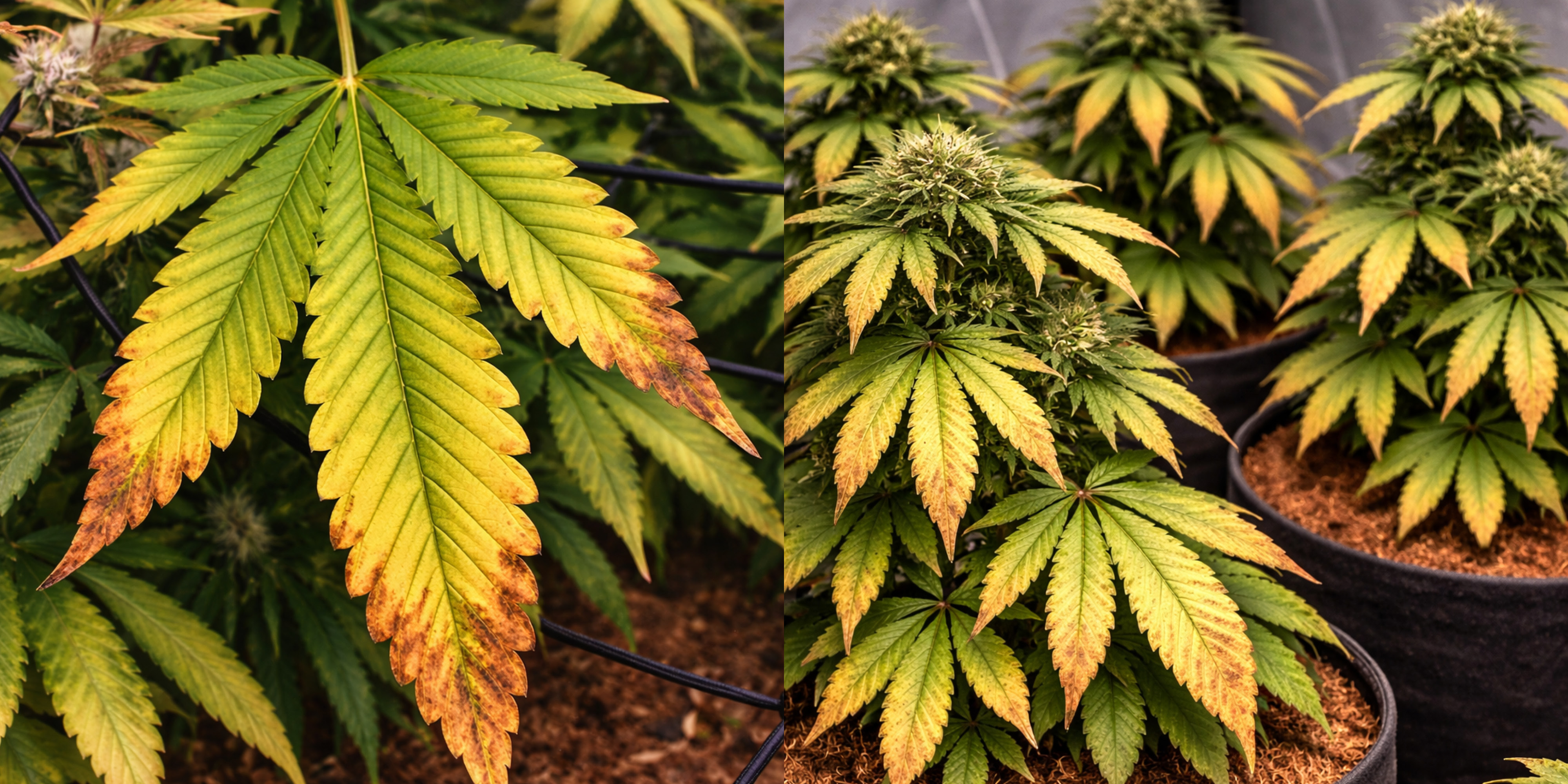
Leaf burn refers to visible damage on plant tissue, typically starting at the tips or edges of leaves and progressing inward over time.
Common symptoms include:
- Burnt leaf tips
- Browning along leaf margins
- Necrotic (dead) tissue
- Leaf curling or deformation
While these symptoms are often attributed to excess nutrients, they are more accurately described as a response to elevated stress within the plant.
This stress can originate from multiple sources, including root zone conditions, irrigation practices, and environmental pressure. The plant responds to the combined effect of these factors rather than any single variable in isolation.
Understanding Root Zone Imbalance
The root zone is where water, nutrients, and oxygen interact. It is also where many plant performance issues begin.
Leaf burn is often linked to imbalance within the root zone, particularly when there is a disruption in the relationship between water availability, nutrient concentration, and oxygen levels.
Substrate EC and Nutrient Concentration
Substrate EC represents the concentration of dissolved nutrients within the root zone.
As substrate EC increases, osmotic pressure also increases. This can make it more difficult for the plant to take up water, even when moisture is present. When water uptake is restricted, nutrient movement slows and stress begins to build.
Substrate EC is influenced not only by the strength of the nutrient solution, but also by how water moves through the substrate.
As water is removed through plant uptake and evaporation, nutrients remain behind. This causes substrate EC to rise over time, even if feeding strength has not changed.
Dryback and Water Availability
Dryback is one of the primary drivers of root zone behavior.
As substrate water content decreases, several things happen simultaneously:
- Oxygen levels increase
- Substrate EC increases
- Water availability decreases
Moderate dryback can improve root function and support plant performance. However, excessive dryback can rapidly increase substrate EC while reducing the plant’s ability to access water.
This combination creates a high-stress environment that often leads to leaf damage.
Irrigation Timing and Consistency
Inconsistent irrigation practices are a common cause of root zone imbalance.
Delaying irrigation too long after lights on, allowing excessive dryback, or applying inconsistent irrigation volumes can all create fluctuations in root zone conditions.
These fluctuations lead to instability in substrate EC, moisture content, and oxygen availability, making it more difficult for the plant to maintain consistent uptake.
A stable irrigation strategy helps maintain balance in the root zone and reduces the likelihood of stress-related symptoms.
Environmental Influence on Leaf Burn
Environmental conditions determine how strongly root zone conditions are experienced by the plant.
Even when root zone conditions are relatively stable, environmental factors can increase plant demand and amplify stress.
Light Intensity
Light intensity drives photosynthesis and directly influences plant demand for water and nutrients.
Higher light levels increase:
- Photosynthetic activity
- Nutrient demand
- Water demand
If the root zone cannot support this increased demand, the plant may begin to show signs of stress, including leaf burn.
Increasing light without adjusting irrigation or root zone conditions can quickly lead to imbalance.
Vapor Pressure Deficit (VPD)
VPD controls the rate of transpiration, or water movement through the plant.
Higher VPD environments increase transpiration, which increases demand for both water and nutrients.
If water uptake is limited due to root zone conditions, the plant can become stressed even when nutrients are present in sufficient quantities.
Temperature
Temperature influences metabolic activity within the plant.
As temperatures rise, so does the rate of physiological processes. This increases the plant’s need for water and nutrients.
If these demands are not met, stress can accumulate and contribute to leaf damage.
Stress Is Cumulative
Plants do not respond to individual variables in isolation. They respond to the total combination of conditions within their environment.
Moderate levels of substrate EC, dryback, and environmental demand may be manageable on their own. However, when these factors occur together, their combined effect can exceed the plant’s ability to maintain balance.
For example:
Moderate substrate EC combined with aggressive dryback and high light intensity can result in significantly higher stress than any one factor alone.
This concept of cumulative stress is key to understanding why leaf burn can occur even when individual variables appear to be within acceptable ranges.
Recognizing Leaf Burn Symptoms
Leaf burn typically develops in stages, beginning with subtle changes and progressing as stress increases.
Early Stage
- Slight yellowing at leaf tips
- Minor tip burn
- Dark green coloration
Moderate Stage
- Browning at leaf tips and edges
- Leaf curling or clawing
- Reduced growth rate
Severe Stage
- Extensive necrosis
- Burnt leaf margins
- Stunted plant development
Once tissue is damaged, it will not recover. The focus should be on improving the conditions that support healthy new growth.
Why Calcium-Related Symptoms Are Often Seen First
In many cases, the earliest visible signs of leaf burn are associated with calcium-related stress.
This is not necessarily due to a lack of calcium in the nutrient solution, but rather how calcium is delivered within the plant.
Calcium is an immobile nutrient, meaning it cannot be redistributed once it has been deposited in plant tissue. It relies entirely on the movement of water through the plant to reach new growth.
Because of this, calcium delivery is highly sensitive to changes in root zone conditions and environmental demand.
When irrigation practices or environmental conditions fall out of balance, calcium is often the first nutrient to show disruption.
Common contributing factors include:
- Excessive dryback, which reduces water availability and increases substrate EC
- Elevated substrate EC, which increases osmotic pressure and restricts water uptake
- High VPD, which increases transpiration demand beyond what the root zone can support
- Inconsistent irrigation timing, which creates fluctuations in water movement
Under these conditions, water movement through the plant becomes limited or inconsistent. Since calcium depends on this flow, new growth may not receive adequate supply even when calcium levels in the root zone are sufficient.
This is why calcium-related symptoms are frequently observed in situations where irrigation strategy or environmental conditions are driving stress.
In many cases, the issue is not the amount of calcium being supplied, but the plant’s ability to move it.
Improving irrigation consistency, managing dryback, and aligning environmental conditions are often more effective solutions than adjusting calcium levels.
The Role of Nutrient Programs
Nutrients are a foundational component of plant growth, but they function within the broader system of root zone and environmental conditions.
A properly balanced fertilizer provides consistent nutrient ratios that support plant development across a wide range of conditions. When nutrient ratios are stable, growers can focus on managing irrigation and environment rather than making frequent adjustments to feeding.
In many cases, plant stress is not caused by incorrect nutrient ratios, but by how those nutrients are being delivered and experienced within the root zone.
Constantly adjusting nutrient ratios in response to visual symptoms can introduce additional variability and make it more difficult to maintain stable root zone conditions.
A consistent, well-formulated nutrient program allows growers to focus on controlling the system rather than chasing individual inputs.
Correcting Leaf Burn
Correcting leaf burn involves restoring balance within the system rather than making aggressive or isolated changes.
Reduce Root Zone Stress
Lowering substrate EC, improving irrigation consistency, and avoiding excessive dryback can help reduce stress in the root zone.
Adjust Environmental Pressure
Reducing light intensity, optimizing VPD, and maintaining appropriate temperature ranges can help align plant demand with root zone capacity.
Stabilize Irrigation Practices
Consistent irrigation timing and volume help maintain stable root zone conditions and reduce fluctuations that contribute to stress.
Allow Time for Recovery
Plants require time to respond to improved conditions. Monitoring new growth is the best way to assess recovery.
Avoid making multiple changes at once, as this can introduce additional instability.
Preventing Leaf Burn
Preventing leaf burn is primarily a matter of maintaining balance and consistency across the system.
Maintain Stable Root Zone Conditions
- Monitor substrate EC and water content regularly
- Avoid excessive dryback
- Ensure adequate irrigation volume
Align Environment With Plant Demand
- Match light intensity to root zone capacity
- Manage VPD to prevent excessive transpiration
- Maintain stable temperature conditions
Use a Consistent Fertilizer Program
- Rely on balanced nutrient formulations
- Avoid frequent changes in feeding strategy
- Focus on delivery and consistency rather than constant adjustment
Observe Plant Signals
- Plants provide early indicators of stress. Recognizing these signals allows for small adjustments before damage becomes severe.
Final Takeaway
Leaf burn is not simply the result of a single input or condition. It is a visible indicator of imbalance within the growing system.
Plants respond to the interaction between root zone conditions, fertilizer formulations, irrigation strategy, environmental demand, and how nutrient ratios are experienced within the root zone.
Maintaining balance across these variables allows for consistent plant performance and reduces the likelihood of stress-related damage.
The most effective approach is not reactive adjustment, but proactive control.
By focusing on substrate EC stability, irrigation consistency, environmental alignment, and a balanced nutrient program, growers can create a system that supports healthy growth and minimizes the occurrence of leaf burn.
Subscribe to our newsletter
Athena® exists to support the modern grower, no matter the scale. Our core principle is to formulate products that improve quality, reduce costs and drive consistency. Athena® was born in the grow rooms of Los Angeles, California, where we are always in pursuit of the perfect run. As the weight of being a cultivator increases, we exist to make the complex simple.
Related posts
What Is Cannabis Photoperiod? A Grower's Guide to Light Cycles
Cal-Mag Deficiency in Cannabis: How to Diagnose Calcium and Magnesium Deficiencies
What Is VPD? Understanding Vapor Pressure Deficit for Cannabis Growing

