




Growing a healthy cannabis plant is only part of the work. Once the plant is harvested, the drying process determines how much of its aroma, flavor, potency, and overall quality reaches the finished flower. A good crop can lose much of its character if it dries too hot, too fast, or in an unstable environment.
Drying removes moisture from freshly harvested flower slowly enough for the inside of each bud to reach equilibrium with the outside. The goal is not to make the flower as dry as possible. It is to lower the water content evenly until the buds are safe to cure without becoming brittle or supporting mold growth.
For most growers, this takes about 7 to 14 days. The exact time depends on temperature, relative humidity, bud size and density, how much plant material is left attached, and how much air moves through the drying room. The calendar is only a reference. The condition of the flower should decide when the dry is complete.
Why Drying Cannabis Properly Matters
Fresh cannabis contains too much moisture to smoke, cure, or store safely. Drying reduces that moisture while protecting the compounds that give each cultivar its distinct effect and aroma. When the process is controlled, the flower keeps more of its terpene profile, burns more evenly, and enters the curing process at a manageable humidity level.
Drying too quickly usually removes water from the outside of the bud before moisture from the center has time to move outward. The surface may feel crisp while the interior remains wet. Fast drying can also flatten aroma and leave the smoke harsh. High temperature, direct light, and strong air directed at the flower all accelerate this problem.
Drying too slowly creates a different risk. Dense cannabis buds can hold moisture deep inside the flower, where stagnant air and high humidity allow mold or bacteria to develop. A musty, ammonia-like, or sour odor is a warning that the material is too wet or beginning to degrade. Flower with visible mold should not be smoked, processed, or mixed with clean material.
The best dry is slow, even, and closely monitored. It preserves quality without allowing moisture to remain trapped inside the bud.
Preparing for the Dry: Harvest and Trim Decisions
Before harvest, make sure the cannabis plant is actually mature. Growers commonly look at trichome development with magnification and use pistil color as a supporting indicator. The exact harvest window depends on the cultivar and the desired finished expression, but immature flower will not improve simply because it is dried well.
Inspect the crop before bringing it into the drying space. Remove any flower showing gray mold, brown collapsing tissue, a dusty appearance, or an unusual odor. Bud rot often begins inside dense colas, so gently separate suspicious areas and inspect the stem and interior tissue. Drying does not make contaminated cannabis safe.
Next, choose between wet trimming and dry trimming. Wet trimming removes most sugar leaves soon after harvest. With less plant material surrounding the buds, moisture escapes faster. This can be useful in a humid environment or when drying space is limited, but it also makes the flower more vulnerable to drying too quickly.
Dry trimming leaves sugar leaves in place while branches or the whole plant hang. The additional material slows moisture loss and offers some physical protection to the trichomes. It often works well in a dry climate or when the grower wants a longer, more gradual dry. The tradeoff is that dry trimming takes more space and may be harder if the leaves wrap tightly around the finished buds.
Neither method is universally better. Match the amount of plant material left on the flower to the drying environment. In higher humidity, smaller branches and more leaf removal can help. In a dry room, larger branches or whole plants help keep the process from moving too fast.
Setting Up a Cannabis Drying Room or Space
A drying room can be a dedicated room, a clean grow tent, or another enclosed area where temperature, humidity, light, and airflow can be controlled. The space should be cleaned before harvest and separated from soil, standing water, living plants, and other sources of spores or pests.
Many growers use the 60/60 rule as a starting point: approximately 60°F and 60% relative humidity. Those conditions generally support a slow dry while limiting mold risk, but 60/60 is a target, not a guarantee. A room at 60% RH can still develop wet pockets when it is overloaded with fresh plants or has poor circulation. Warmer rooms may require a slightly lower humidity level, and drier rooms may require a humidifier or more plant material left attached.
Use a calibrated thermometer and hygrometer to track conditions. Place sensors near the hanging flower rather than directly beside a dehumidifier, humidifier, supply vent, or wall. In a larger room, use more than one sensor because the warmest, coolest, wettest, and driest locations may be different.
Keep the room dark. Light and heat can degrade cannabinoids and volatile terpenes, and light provides no benefit after harvest. Seal out sunlight and turn work lights off when no one is in the room.
The basic equipment may include:
- A thermometer and calibrated hygrometer
- A dehumidifier, humidifier, or both, depending on the climate
- Gentle circulation fans that do not blow directly on the buds
- Hanging lines, hooks, or clean drying racks
- Heating or cooling equipment capable of maintaining a stable temperature
Size the environmental equipment for the moisture load, not only the empty room. Freshly harvested cannabis releases a large amount of water during the first several days, so humidity can rise quickly after the space is loaded.
Drying Methods: Whole Plants, Branches, and Racks
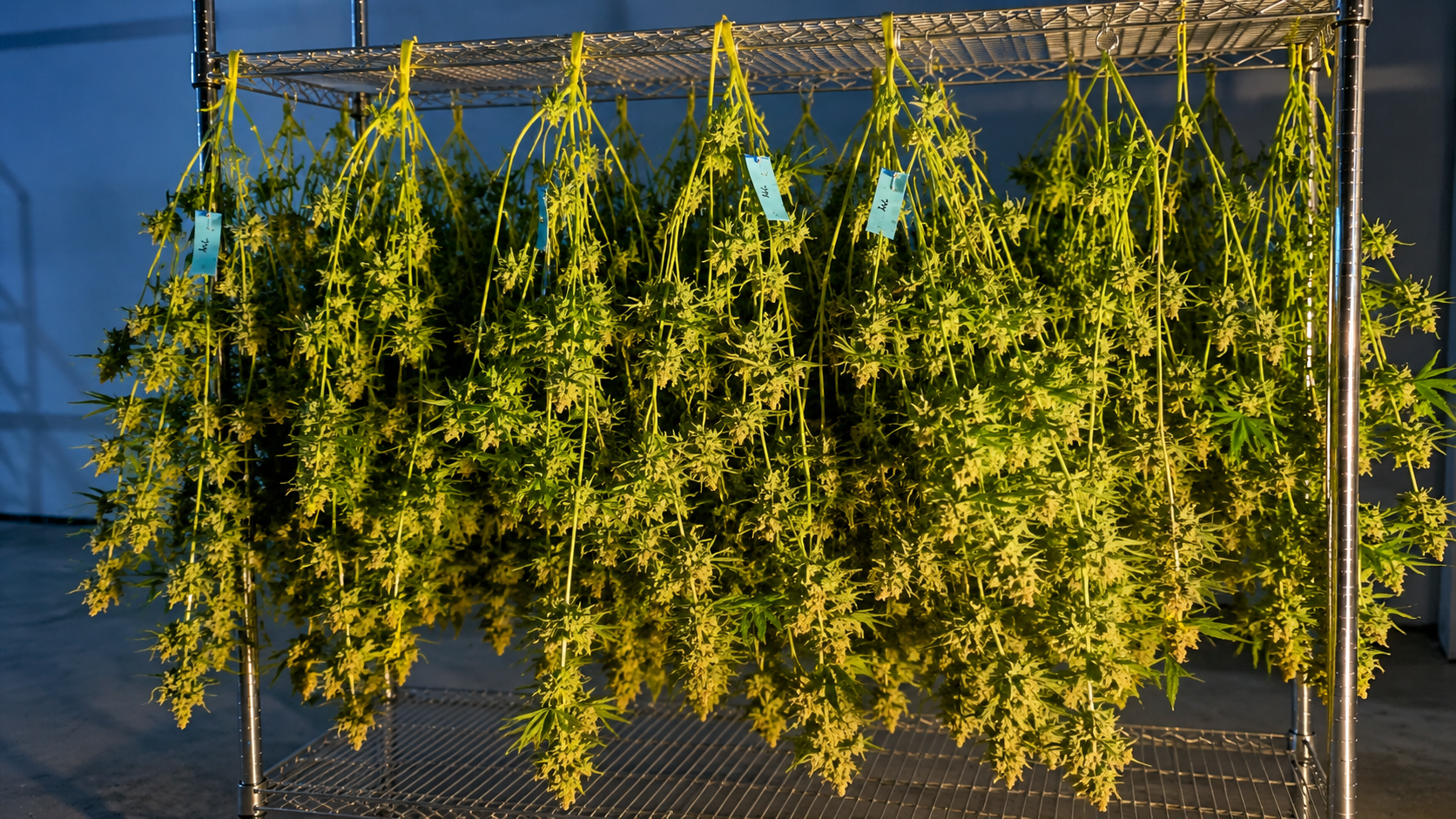
Whole-plant hanging is one of the slowest ways to dry cannabis. The roots are removed, large fan leaves may be taken off, and the plant is hung upside down with branches intact. Because the stems and leaves hold additional water, whole plants can help prevent an overly fast dry in an arid climate. They also require more space and may dry unevenly if branches overlap.
Branch hanging is a flexible middle ground. Cut the plant into sections that can be spaced without touching. This improves air circulation and lets growers separate large, dense colas from smaller flower that may finish sooner. Keep enough stem on each branch to slow the dry and provide an easy hanging point.
Drying racks are useful for wet-trimmed buds, smaller branches, or rooms without enough hanging height. Spread the cannabis buds in a single loose layer. Do not pile or compress them. Turn the flower gently when needed so the contact side does not remain damp or become flattened. Handle it as little as possible because dry trichomes break away easily.
Whichever method is used, leave space around the material. Crowding creates small zones of high humidity and stagnant air. A full room should still allow air to move around every plant, branch, or rack without the flower swinging in a direct breeze.
Managing Temperature, Humidity, and Airflow
Conditions naturally change during the dry. In the first 24 to 72 hours, fresh flower releases moisture rapidly and the dehumidifier may run often. Later, the moisture load falls and the same equipment settings can make the room too dry. Monitor the environment throughout the process rather than setting it once and walking away.
Temperature influences both evaporation and quality retention. Warm air speeds moisture loss and increases the loss of volatile aroma compounds. Cooler conditions slow the process, but cooling equipment may also change relative humidity. Aim for stability and avoid large day-to-night swings.
Humidity controls how quickly moisture leaves the plant. If RH remains too high, increase dehumidification, reduce room loading, or improve general air mixing. If RH is too low, reduce dehumidification, add humidity carefully, or slow the dry by hanging larger sections. Do not mist the flower.
Airflow should mix the room without stripping moisture from the bud surface. Point fans toward open space, walls, or below the hanging canopy rather than directly at the flower. Leaves should not flutter continuously. Direct fan exposure can produce a crispy exterior and a wet center, making the buds appear ready before they are properly dried.
Check different areas of the room every day. Smell the air, feel representative buds, inspect dense flowers, and compare sensor readings. If one side consistently finishes first, adjust spacing, fan direction, or equipment placement before the next harvest.
Monitoring the Drying Process
Drying time is commonly 7 to 14 days, but a whole plant in cool, humid conditions may take longer, while small wet-trimmed buds in warm, dry air may finish much sooner. A fast result is not necessarily an efficient result. If the crop is dry in three or four days, conditions were probably too aggressive for ideal quality.
During daily checks, look for an even change in texture. At first, leaves wilt and the outside of the flower feels damp. Over time, the surface becomes drier, the buds feel lighter, and the aroma shifts from fresh-cut plant material toward the cultivar’s finished profile.
Do not squeeze every cola. Choose samples from different parts of the room, including large and small buds. Gently bend the smaller stems. Early in the process they fold and feel wet. Near the end, small stems begin to crack or snap while larger stems may still bend. The outside of the flower should feel dry but not brittle, and the bud should retain a little resilience when lightly pressed.
The stem snap test is useful, but it should not be the only test. Stem thickness varies, and thin stems can snap while the center of a dense bud still holds excess moisture.
A better confirmation is to place a representative sample in a sealed jar with a small hygrometer for several hours. If humidity climbs above the mid-60% range, the interior is still releasing too much moisture and the batch needs more drying time. If it settles around the low 60s, the flower is generally ready to begin curing. Equipment accuracy and local process targets still matter.
Common Drying Mistakes and How to Avoid Them
The most common mistake is trying to force the process with heat or direct airflow. Space heaters, ovens, microwaves, and hot fans may make cannabis feel dry quickly, but they produce uneven moisture, reduce aroma, and can make the smoke harsh. Give internal moisture time to migrate toward the surface.
Another mistake is trusting one sensor. A hygrometer only describes the air around it. It does not reveal a wet pocket inside a cola or a humid corner behind a rack. Calibrate sensors, use multiple locations when possible, and confirm the readings with physical inspection.
Overloading the drying room can also overwhelm the dehumidifier and restrict airflow. If branches touch, racks are packed tightly, or room humidity cannot recover to the target, reduce the load. More drying density is not useful if it puts the harvest at risk.
Avoid using orange peel, bread, or other food to rehydrate overly dry buds. These materials introduce uncontrolled moisture and may carry mold or bacteria. A commercial humidity pack can help stabilize already dried flower, but it cannot restore terpenes that were lost during an excessively fast dry. Prevention is more effective than rehydration.
Finally, do not combine wet and dry material in the same curing container. A few moist buds can raise the humidity of an entire container and increase the chance of mold.
Transitioning from Drying to Curing
Drying and curing are connected, but they are not the same process. Drying removes most of the water needed to make cannabis stable enough for a sealed container. Curing allows the remaining moisture to equalize through the buds while aroma, flavor, and smoke quality continue to develop.
After dry trimming, place the finished flower loosely into clean, airtight glass jars or another food-safe container. Do not pack the buds tightly; leave headspace so they can be moved and inspected. Add a small hygrometer to monitor humidity inside the container.
During the first week, check the jars at least daily. If the flower feels damp again or the humidity rises above the desired range, remove it and return it to open air for additional drying. If conditions are stable, open the containers briefly to exchange air and inspect the aroma.
A sharp ammonia smell signals excess moisture and possible microbial activity. Separate and inspect the material immediately rather than trying to hide the odor with more air exchange.
Properly dried cannabis enters the curing process gradually. It should not crumble into dust, feel wet when compressed, or stick together in a dense mass. The goal is an even internal moisture level that can be managed safely in a sealed environment.
Knowing When Cannabis Is Properly Dried
Cannabis is ready to cure when several indicators agree: the flower feels dry on the outside, small stems crack or snap, larger stems are no longer wet and flexible, and a sealed sample stabilizes near the intended curing humidity. The aroma should be recognizable and clean, without musty, sour, or ammonia-like notes.
Can cannabis be dried in a grow tent? Yes, if the tent is clean, dark, and equipped to control temperature, humidity, and airflow.
Can it be dried outdoors? Technically, but outdoor conditions are difficult to control and expose the harvest to sunlight, temperature swings, pests, dust, and moisture. An enclosed space produces a more repeatable result.
Can dried cannabis go bad? Yes. Even properly dried flower can develop mold if it is sealed while too wet, exposed to new moisture, or stored in unstable conditions. Excessive heat, light, air exposure, and very low humidity can also reduce quality over time.
The most reliable way to dry cannabis is to control the room, observe the flower, and make small adjustments before conditions drift. Temperature and relative humidity create the drying environment, but touch, smell, stem behavior, and a sealed-sample test confirm what is happening inside the bud.
A successful dry does not call attention to itself. It simply carries the work from harvest into curing with the cultivar’s aroma, potency, structure, and smoke quality still intact. Slow the process down, keep it even, and let the condition of the flower, not a fixed number of days, tell you when it is ready.
Subscribe to our newsletter
Athena® exists to support the modern grower, no matter the scale. Our core principle is to formulate products that improve quality, reduce costs and drive consistency. Athena® was born in the grow rooms of Los Angeles, California, where we are always in pursuit of the perfect run. As the weight of being a cultivator increases, we exist to make the complex simple.
Related posts

Wet Trim vs Dry Trim: Understanding Cannabis Trimming Methods
What Is Cannabis Photoperiod? A Grower's Guide to Light Cycles
Cal-Mag Deficiency in Cannabis: How to Diagnose Calcium and Magnesium Deficiencies

